[Originally published in The Architectural Review July-August 2019]
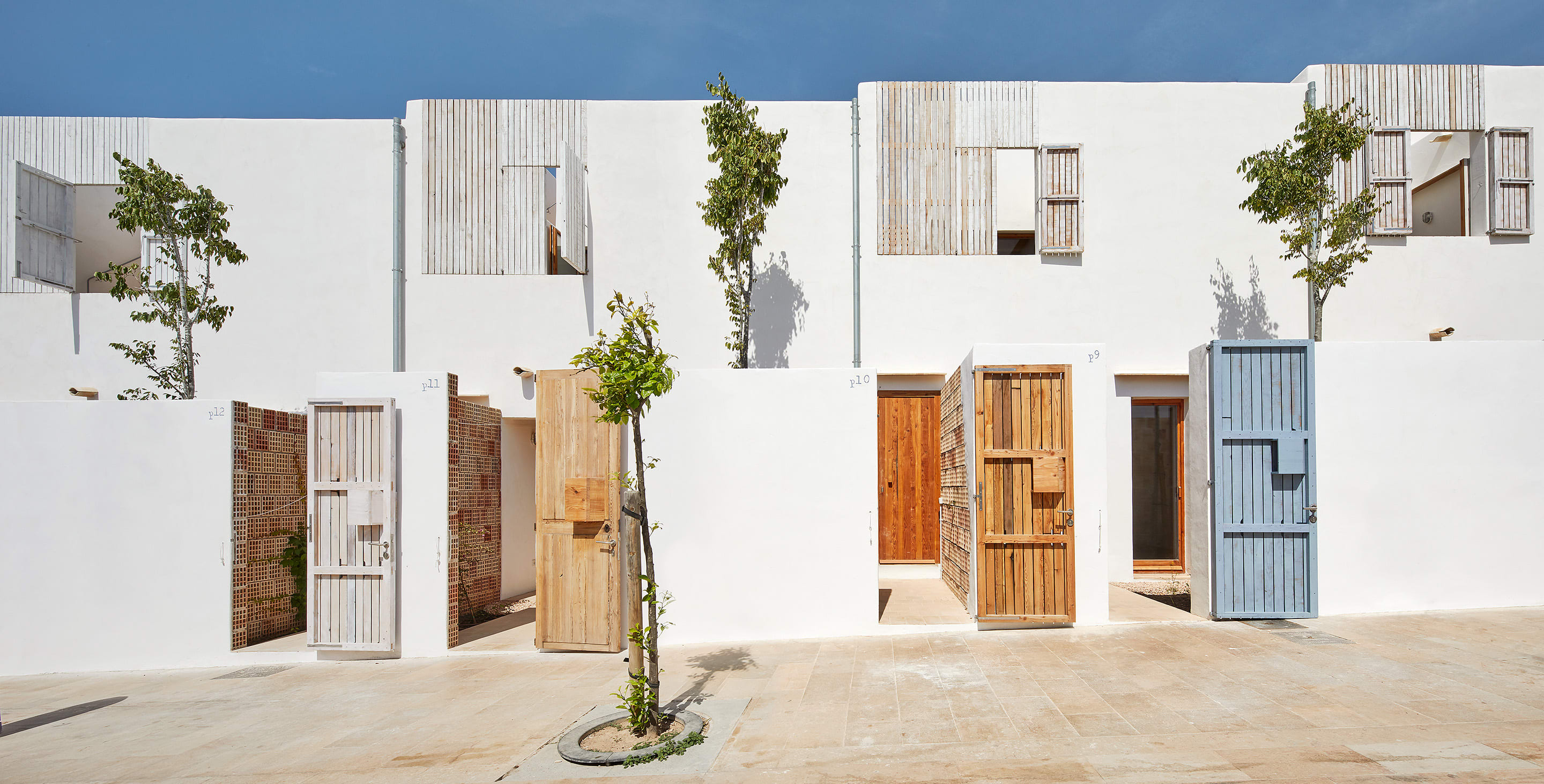
The small, idyllic Mediterranean island of Formentera, Spain, isn’t the first place that comes to mind as a hotbed of architectural experimentation. Yet it is home to a pair of discreet terraces that constitute an ambitious experiment into low-carbon housing construction; a research project replete with support from the European Union, governmental agencies, and universities in which research into extinct vernacular building traditions was undertaken, carbon footprints of a wide-range of building materials were calculated, and energy consumption is being monitored now, in the post-occupancy stage. These rather quaint terraces belie experimentation that aims to change nothing less than the way we build.
True, we normally associate “experimentation” with a deeply personal artistic search for novel architectural form rather than with an effort to improve building performance. But if carbon emissions from the construction sector are to be significantly lowered, then what we need are verifiable, conclusive scientific studies confirming what is truly “green” as opposed to merely “green-washing”.
Completed in 2017, Life Reusing Posidonia is a publicly-built affordable rental housing project designed by civil-servant architects of the Instituto Balear de la Vivienda (Balearic Housing Institute), or IBAVI for short; a public agency of the Regional Government of the Balearic Isles’ Ministry of Agriculture, Environment and Territory that is responsible for providing and maintaining social housing in this Mediterranean archipelago. Normally, social housing projects in Spain are awarded through architectural competitions organized by municipal or regional authorities, but in the case of small projects, they may be done by in-house architects. In this case, the Balearic Housing Institute wanted a pilot project with which to test and establish new, more stringent energy-efficiency requirements for future architectural competitions.
To this end, in 2012, IBAVI applied to the European Union LIFE+ 12 program for a Climate Change Adaptation project grant with the support of the Balearic General Directorate of Energy and Climate Change, receiving 754,012.00 €, or almost half the building’s construction budget, to “demonstrate the feasibility of developing a multifamily residential building with a significantly reduced ecological footprint”. Architect Carles Oliver of IBAVI remarks that “This EU grant program is intended for ‘nature conservation’ and ‘climate change adaptation’ projects. This is only the second ‘architectural’ project to be awarded such a grant in Spain.”
[To continue reading, please visit The Architectural Review]
 Criticalista
Nice sharee