[Originally published in Bauwelt 9.2024]
The suburban single-family house has long been promoted as the ideal residential building type; as something to aspire toward. But since the 1980s and the rise of conspicuous consumption, this kind of house has become bloated in size and price, placing it beyond the economic reach of the young while increasingly isolating its elderly inhabitants within a mindless urban sprawl. This situation is generating demand for more diverse residential building types in the peripheries of our cities; for alternatives to the hegemonic single-family house. But of course, to meet with local acceptance, especially in affluent neighborhoods, such alternatives cannot appear –outwardly at least– to disrupt business-as-usual, and so must nevertheless often resemble single-family houses architecturally.
The strategy of ‘everyday camouflage‘ is precisely what OF Architects (Arantza Ozaeta, Alvaro M. Fidalgo) together with Ignacio G. Galán have cleverly applied in their project Beyond-the-Family Kin House. Located in the Madrid suburb of Peñagrande and containing an additional rental flat within its walls, Beyond-the-Family Kin House was commissioned by a retired couple of empty nesters who desired to age in place without suburban isolation and ennui. The idea was to enable intergenerational interdependence beyond that of the traditional family, while avoiding yet another duplex with identical dwellings.
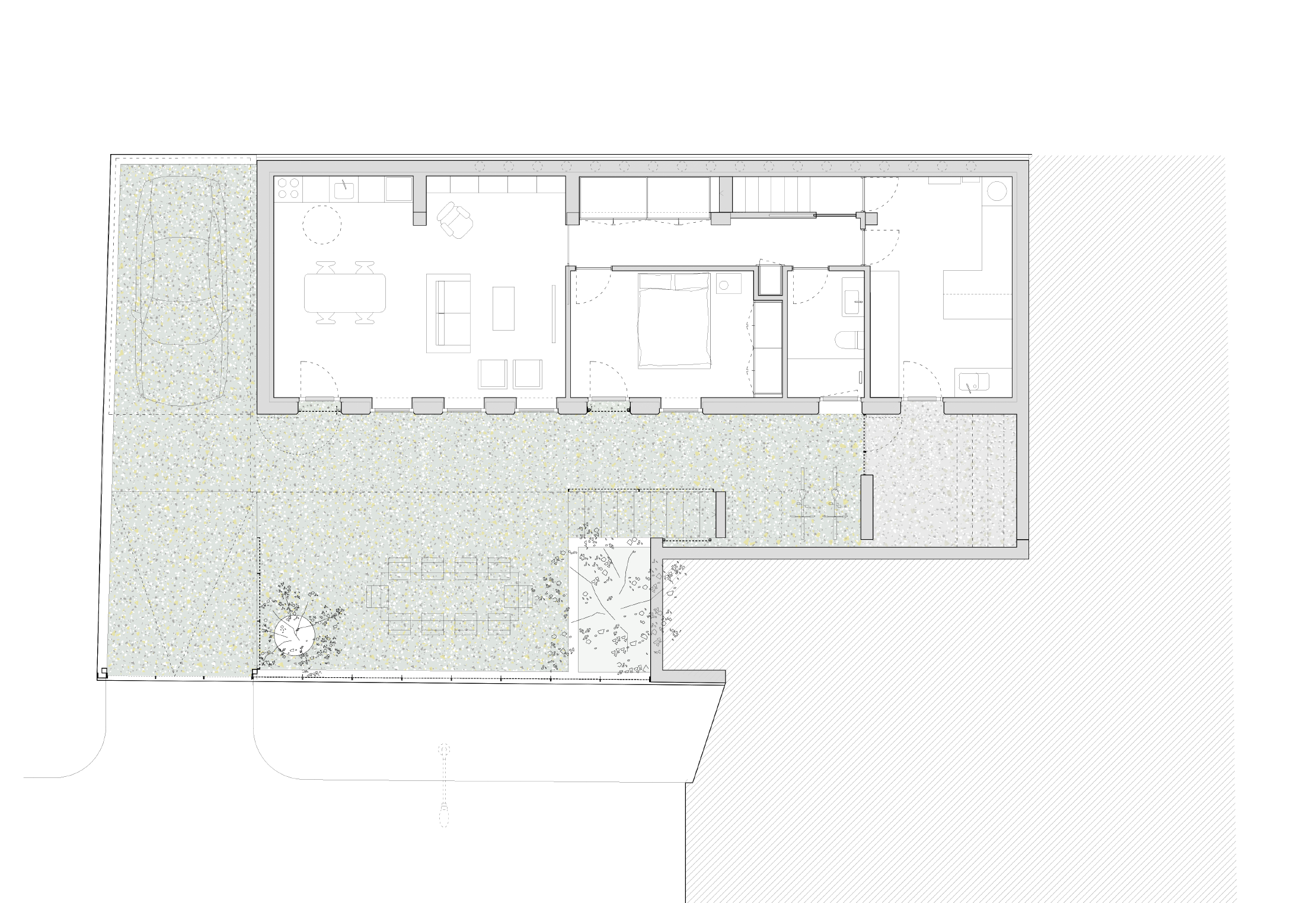
This compact, colorful, and idiosyncratic multi-residential house bookends a terrace of much larger single-family brick rowhouses, not unlike the canonical Rietveld Schröder House near Utrecht. Its intricate architecture combines living quarters for the owner-couple on the main floor together with a guest suite for their visitors above, as well as a completely independent flat one floor below for a caretaker or a student (the house is near a university campus). Moreover, it takes full advantage of its street corner plot and sloped topography to provide each dwelling with distinct entrances through private gardens at different levels and at opposite ends of the house. “The street sidewalk is the wheelchair ramp that connects the two main dwellings”, remark the architects, who go on to explain that they were approached from the outset to find a site for this project in addition to designing it and overseeing its construction.
The neighborhood, which is situated very close to where the client couple raised a family, is a curious mix of 1990s suburban rowhouses interrupted by sporadic older farmhouses that provide some existing, smaller-scaled, local historical precedent. This agrarian past as well as a nearby light-industrial context is acknowledged in the design through an architectural form strongly characterized by a corrugated metal-clad sawtooth roof as well a series of openings, nooks and corners that are seemingly cut out —or sawn out— of the building mass. “Rather than maximize the envelope and consolidate all outdoor space within a single back yard, like most row houses, we opted to make a smaller building and distribute multiple outdoor spaces all around,” explain the architects. A series of pleasant gardens and terraces at each of the house’s three floor levels thereby lends indoor spaces plentiful biophilia and a greater sense of well-being.
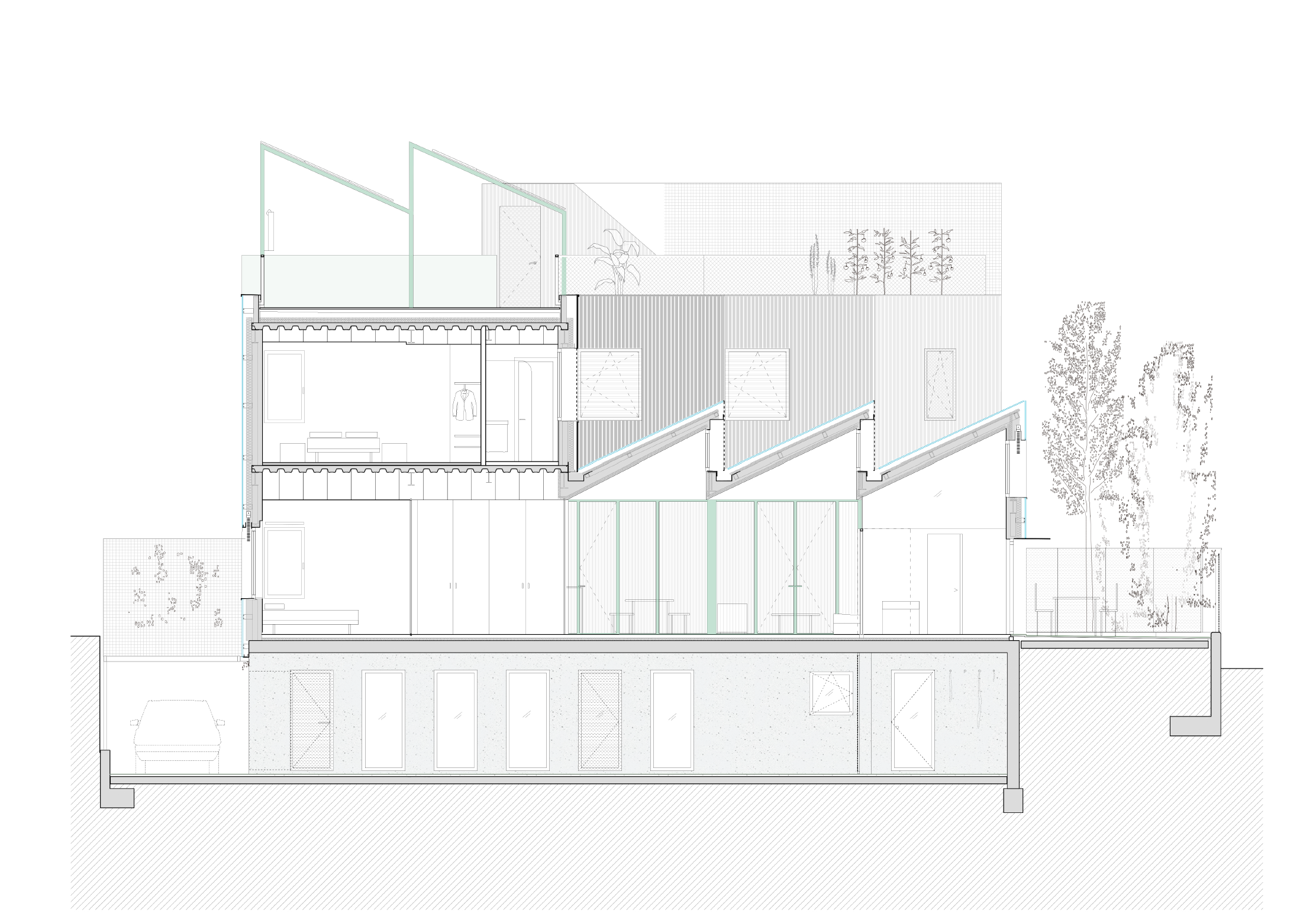
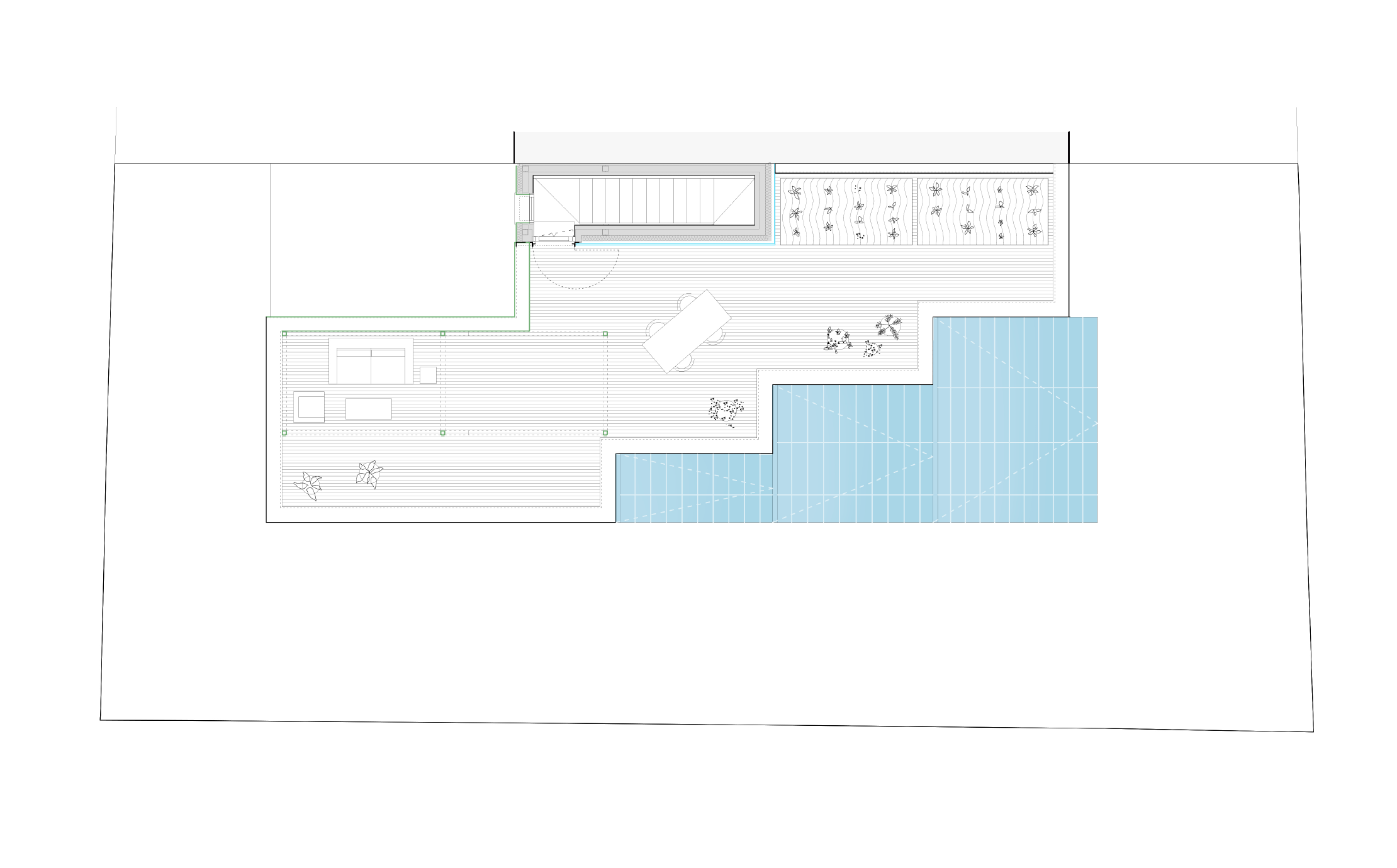
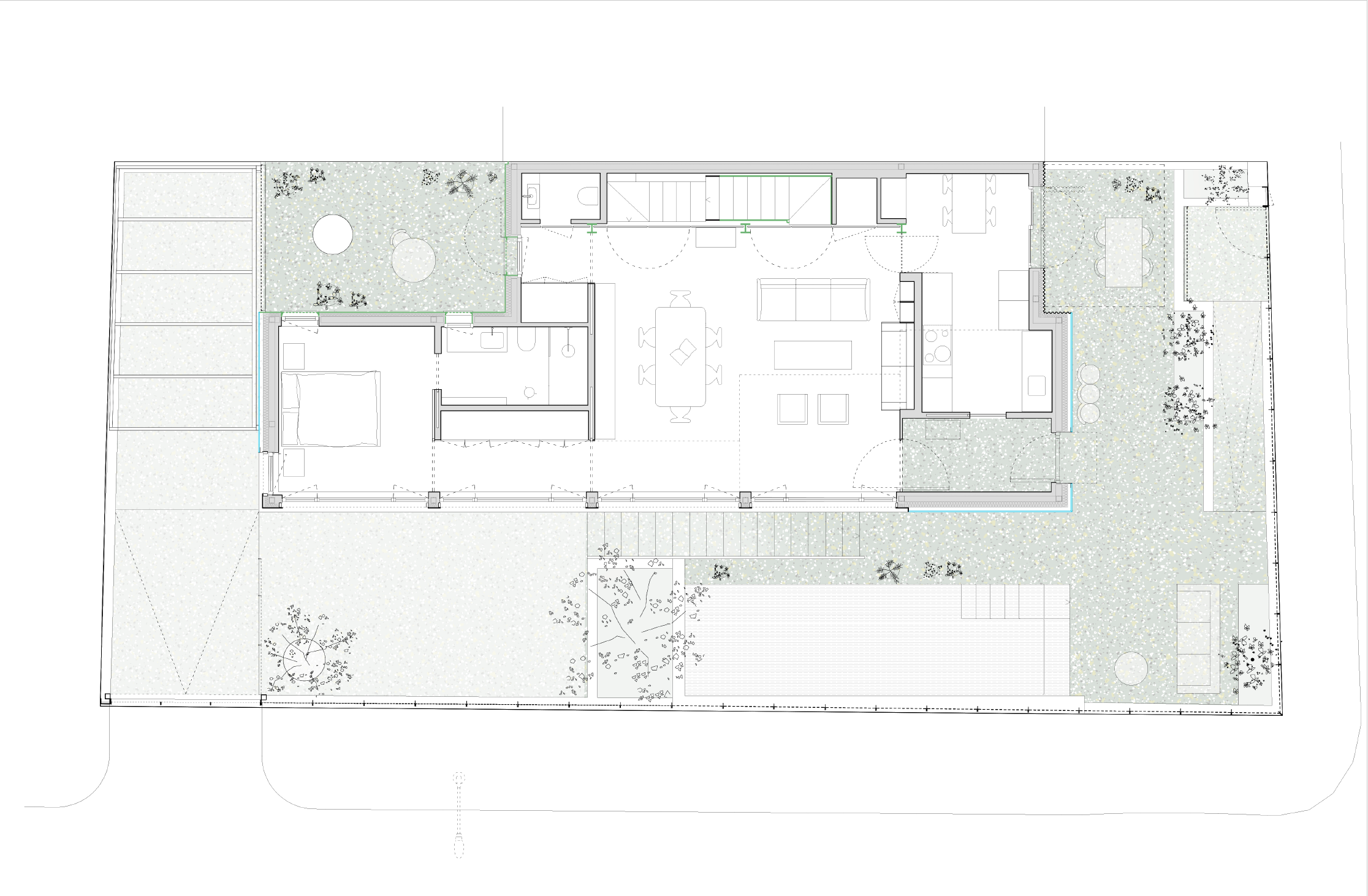
The house features a small private front garden at the highest elevation from which the couple’s dwelling is entered, another private garden where the lower flat is entered, and a small swimming pool in a side yard in-between. Outdoor spaces are also provided above ground: a main floor rear terrace contains an impressive collection of bonsai trees and the house’s flat roof features a terrace with a sawtooth-shaped pergola.
Beyond-the-Family Kin House only has one outdoor parking space at the rear that moreover doubles as extra patio space in the absence of a car. This omission of a garage, a regular fixture of suburbia, as well as its situation on a corner site permits this closer and more intimate relationship between inside and outside. The integration of the architecture with the sloping terrain is moreover exquisitely handled, demonstrating a firm grasp of ‘ground control.’
This two-unit house may be significantly smaller than its neighbors, but its biophilic spaces are much higher quality. The couple’s dwelling, which is entirely wheelchair accessible, has been designed so that they can fully live their indoor and outdoor lives on one level only, if need be. Their entrance hall leads directly into a bright and generously proportioned living and dining room, behind which lies the couple’s bedroom and bath; a private area that, owing to the descending topography, is elevated a floor level above ground at that point. The kitchen is at the front, next to the entrance hall, and features a small informal dining area whose sliding doors open directly onto a south-facing outdoor patio shaded by trees.
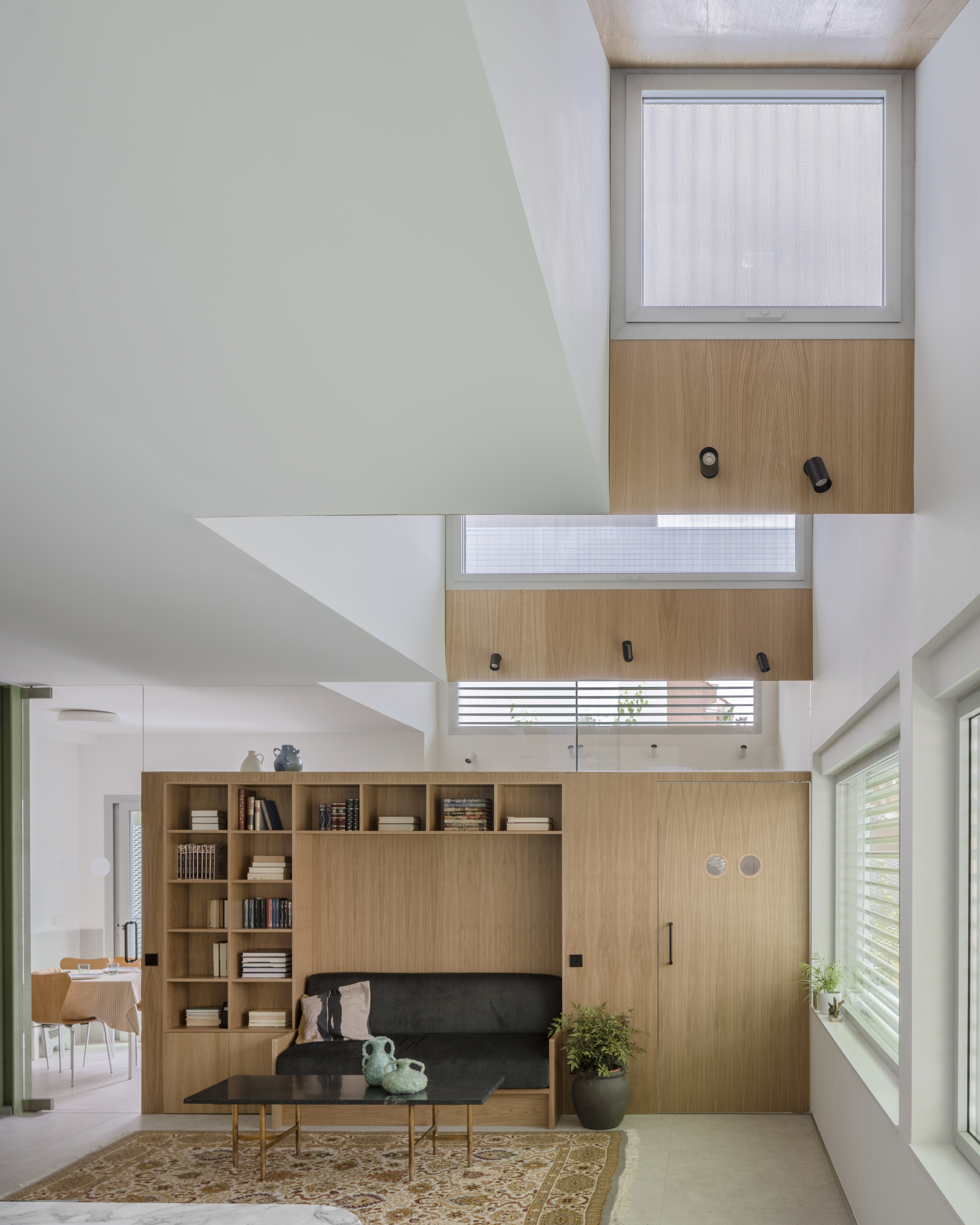
The couple’s living-dining room is the heart and soul of the house, the central space from which other spaces emanate. “We had to design the living-dining room around a very long antique credenza belonging to our client,” explain the architects. Containing a formal dining area as well as lounge seating that is built into a handsome wood-crafted bookcase partition screening the kitchen, the living-dining room is bathed with natural light from windows overlooking the side yard as well as clerestory windows in the sawtooth ceiling.
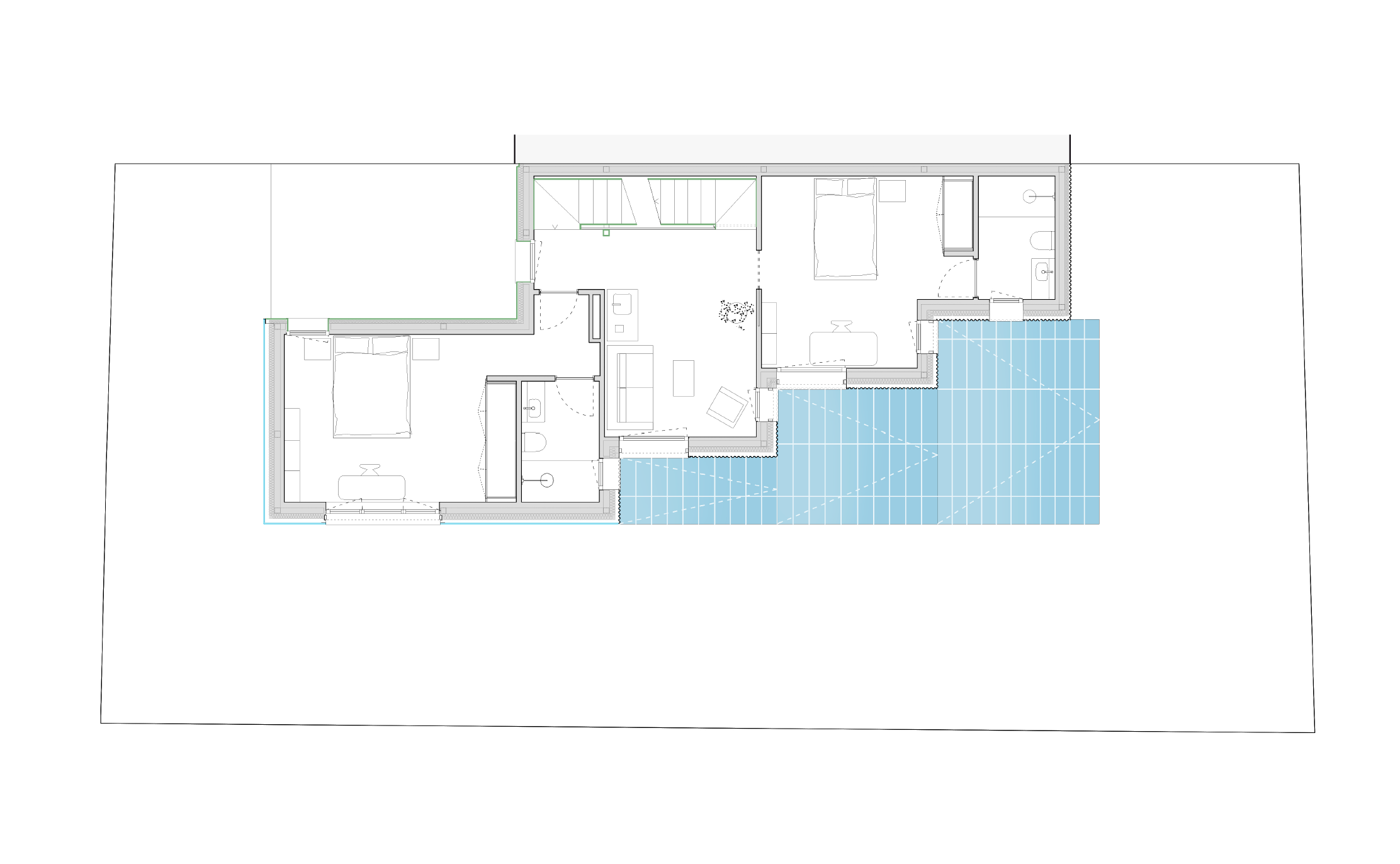
From the living-dining room, a pair of polycarbonate doors lead to a pair of stacked single-run stairways separating this space from the party-wall of the house. One stair descends to the independent flat as well as to mechanical spaces below, while another ascends to the lounge of an upper-floor guest suite consisting of a lounge flanked by a pair of bedrooms for visiting friends or relatives to stay in. The guest suite is articulated around the sawtooth roof of the living-dining room below, creating corners with windows orientated in different directions. The stairway then continues up one more flight to the roof terrace. Here, the rooftop photovoltaic pergola (in conjunction with a battery) supplies 80% of the power consumed by the house, which uses an air-source heat pump in conjunction with in-floor radiant heating and cooling. Natural cooling through ventilation is also achieved by means of a mechanical north-facing vent operated by thermal sensors that transform the stairwell into a thermal chimney.
With its idiosyncratic architecture and multiple gardens, Beyond-the-Family Kin House certainly appears from the outside to be a single-family house, belying the complex duplex that is contained within. But its multiple living arrangements are moreover flexible, permitting different kinds of social relations through architecturally adjustable degrees of privacy and community. The house can thus nevertheless be transformed into the very thing it both critiques and emulates, if desired. What has been created here, in the end, is simply a much better house.
[All images courtesy OF Architects]
 Criticalista