The Line, that gigastructure for Saudi Arabia that has recently been reduced to only a tiny fraction of its initially planned length of 170 km, has received a great deal of criticism since its announcement; most of it deserved. Nevertheless, this project does (did?) have two laudable goals: to reduce land consumption, and to build a car-free city, both of which go together. The automobile has dominated the design of the built environment for a good part of a century until only relatively recently, ever since global heating started to become palpable, so it’s high time the car-free city were seriously researched. And no, the electric car, which consumes ten times the amount of critical raw materials that a fossil fuel car consumes, is not a sustainable mass-replacement of the traditional car. We simply have to stop designing cities around mass car-ownership.
But just how should a city without private cars be designed? Undoubtedly around some sort of combination of a public transportation system and walkability / cycleability, which entails a high level of urban compactness and density. But is a super-tall, narrow, and densely packed linear gigastructure stretched out along a high-speed train line the best way to design a car-free city?
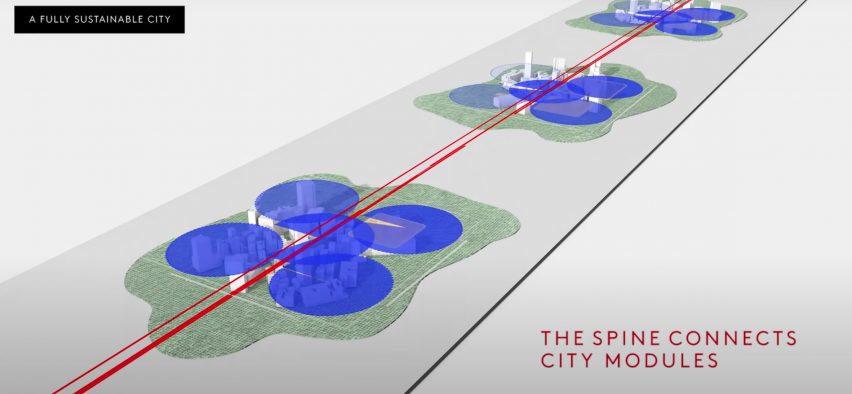
High speed trains are inter-urban transportation, not a form of urban transportation. The train stations of a high speed train line cannot be situated very close together, as if they were subway stations. The Madrid-Barcelona high-speed train, for example, a distance of 506 km, has only 5 stops in-between, an average of 84 km between stations. Yet, as the above diagram of The Line shows, ‘City Modules’ presumably served by high-speed rail stations appear to be only a little further apart than the width of The Line (200 m). Or am I reading this wrong? Perhaps trains whizz through most of the city modules without stopping, connecting only a few of them, and there’s a secondary slower parallel public transportation system connecting the stations you just whizzed through… Doesn’t really make much sense, does it?
Designing a car free city as a linear city is, perhaps, not a very good idea in the end: it is based on the mistaken premise that urban form follows inter-urban transportation. A railway line is not a line at all, in fact, but a series of points; the faster the train, the further apart the points. The best way to connect a series of points is not to line them all up, but to distribute them into a network that is interconnected in multiple directions.
But here’s the other thing: we have lots of low-density sprawl all over the world precisely because so much urban fabric was designed around the automobile. Before we go building new cities for 9 million inhabitants in virgin deserts, perhaps it would make more sense to rebuild and densify all that existing urban sprawl, infilling and replacing outmoded buildings such as single-family detached houses nobody can afford anymore (not to mention dead malls) with new, much denser housing served by trams and buses and commuter train lines, and yes, high-speed rail connecting the most important urban centers, and even some EVs. I know this idea sounds quite conventional, but we can always give such densified urban fabrics catchy new names such as ’15 minute cities’ if need be. The important thing is to work incrementally and to improve the cities we already have. The Line? Good riddance!
 Criticalista
1 Comment