[Originally published in the September 2024 issue of The Architectural Review]
Comfort is the reason we construct most buildings. The weather on Earth can often be too cold, too hot or too wet for us, and buildings allow us to create a more favourable microclimate. Ever more complex mechanical systems have been created to maintain ever greater levels of comfort in buildings, making it possible to inhabit glass‑clad skyscrapers in the middle of deserts. Modern air conditioning is undoubtedly the technological invention that has brought the most freedom to architecture, liberating form and materiality from climatic considerations.
But we are now discovering the cost and limitations of this freedom. The climate emergency is creating a growing thirst for air conditioning in places where it was previously unnecessary, increasing greenhouse gas emissions that in turn further contribute to global heating. Air conditioning is not the solution to climate change; instead, it has created a vicious circle, and vicious circles cannot go on indefinitely. Like other modern technologies, it is hard to believe that our ancestors once lived without air conditioning – but this may be the case once again for our descendants.
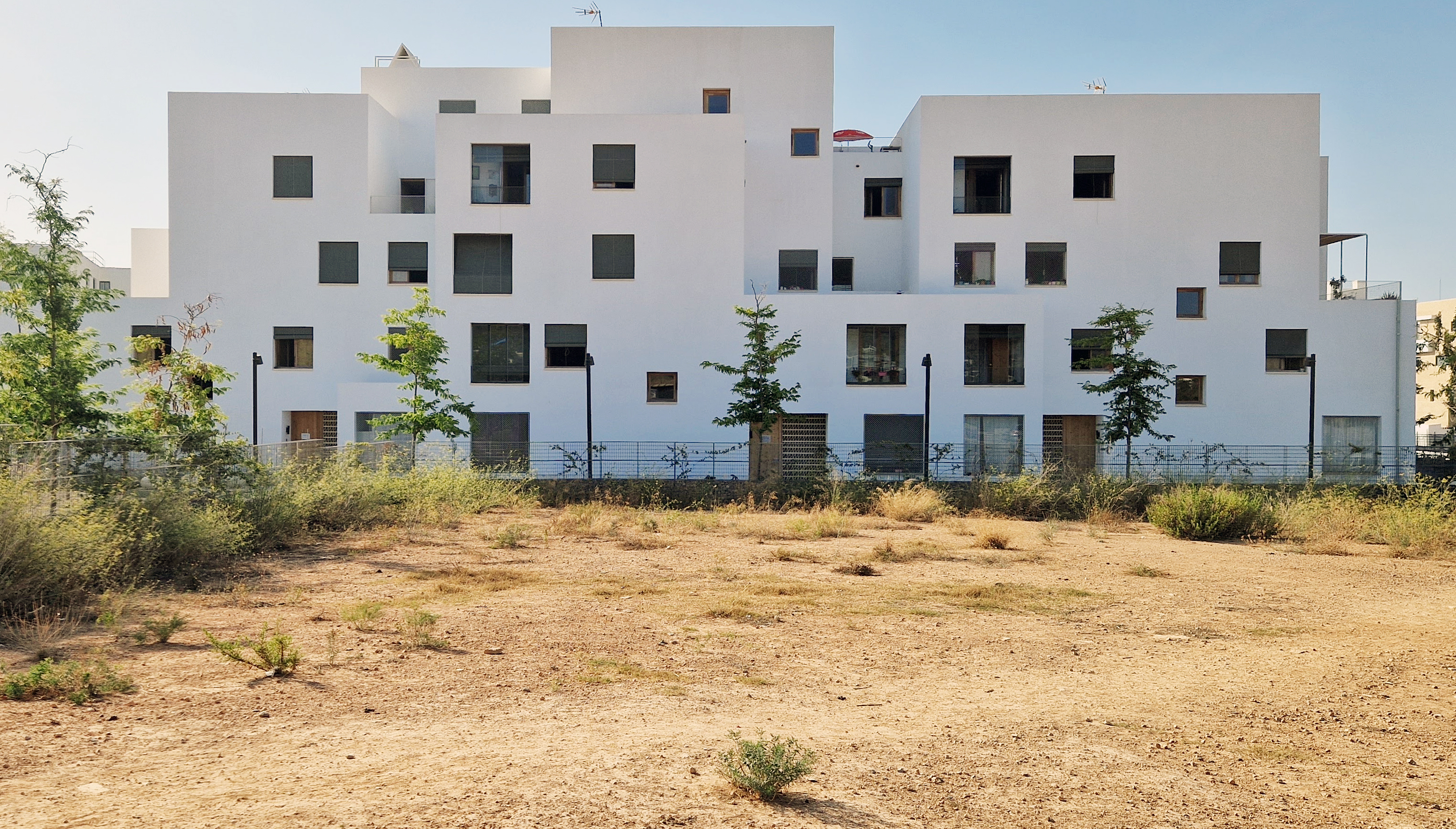
There is no need to sweat, however. An experimental building containing 43 social housing units has been built on the Spanish island of Eivissa (known more commonly as Ibiza), delivering adequate year‑round comfort, without any mechanical heating or air conditioning. One of the key building materials that makes this possible is earth.
Completed by Peris+Toral Arquitectes after winning a competition organised by the government agency Institut Balear de l’Habitatge, the building is primarily constructed of compressed stabilised earth block (CSEB) walls; at five storeys, this is currently Spain’s tallest building constructed of CSEB. Rather than cement, the compressed earth blocks are stabilised with hydraulic lime, which emits less CO2 when manufactured; the carbon footprint of lime‑stabilised CEBs is roughly half that of fired clay bricks or concrete blocks. […]
[To continue reading please visit The Architectural Review]
 Criticalista