[Originally published in de Aedibus 110: CLR Architectes]
By their ability to offer a threshold between the city and the habitat, [transitory spaces] valorize a valuable intermediate scale that softens the abrupt legal divide between public and private space.
-Patrick Longchamp, CLR Architectes1
Architecture always mediates. It shelters from extreme climate and protects from intrusion while facilitating and affirming all sorts of human activity. Mediation occurs between inside and outside and between private and public; doing so either through a single membrane or through an ‘intermediary space’ that is transitory and that uses multiple membranes that are moreover permeable. The former is abrupt while the latter is gradual, offering opportunities for human activity that is not necessarily scripted or programmed.
In the work of CLR Architectes, transitory or intermediary spaces figure prominently. Examples of these kinds of spaces are porticoes, loggias, courtyards, patios, porches, arcades, gallerias, passageways, halls and vestibules, to name only some. They are typically situated between outside and inside, and between public and private, acting as thresholds or filters between very different environments. They are also usually unprogrammed, fulfilling more of an urban role than a functional one. In cities, these kinds of spaces perform an invaluable service, as they buffer noise and other nuisances in environments of high urban density. As spaces of transition they invite lingering, not to mention the possibility of chance encounters and informal sociability between neighbors. They are the architectural spaces of urbanity and community par excellence.
Precisely because of these qualities, intermediary spaces also lend themselves to appropriation and hence to play. Play is an essential component of all artforms. Johan Huizinga explains that play is “an activity which proceeds within certain limits of time and space, in a visible order, according to rules freely accepted, and outside the sphere of necessity or material utility.”2 Play is superfluous yet meaningful, argues Huizinga: “In play there is something ‘at play’ which transcends the immediate needs of life and imparts meaning to the action. All play means something.”3
In architecture, play can be seen as the very element that defines the ‘art’ of this discipline, distinguishing it from pure utility or instrumentality. Le Corbusier defined architecture as “the skillful, rigorous and magnificent play of volumes under the light.” Architectural composition, spatial organization and thematic variation are a game that is played, replete with certain rules to follow. Or not: “The game of architecture is an intricate play with rules that you may break or accept,” according to Bernard Tschumi (emphases added).
CLR plays the game of architecture according to unwritten but evident rules of their own. Firstly, play takes place mostly in unprogrammed spaces that nevertheless serve an urban function, without affecting performative aspects of building such as safety, utility, or energy efficiency. Secondly, play takes the form of variations on a theme and of repetition with differences, not unlike the way music is structured and played. Finally, architectural play is intended, in turn, to encourage free play on the part of building users. Offering the possibility of play becomes, for CLR, a public service of architecture.

A small house addition by CLR illustrates the element of play within intermediary space. Cast entirely in light concrete, Maison F2 is a volume added onto the front of an older house in the suburbs of Geneva. It features traditional punched openings in walls as well as in the roof that let sun or rain pass through, creating a certain ambiguity: is this an unfinished construction with openings awaiting the installation of windows and a skylight, or is it an outdoor space with some vertical and horizontal cover for extra privacy and shade, framing the views ? It turns out to be the latter, of course: a climatic in-between space with characteristics of both indoor and outdoor environments. Here, play is licensed by architectural ambiguity and irreverence; a game of “identify the architecture” is offered. It is precisely the intermediary nature of the space that harbors ambiguity and playfulness.

A similar game is played at the intergenerational housing project Les Communailles and at the social housing complex Les Marbriers. Both projects employ a precast concrete construction system in which façade openings shift subtly from side to side rather than lining up vertically and orderly. This permits a complex game of “Tetris minéral” (as the architects themselves name it) to be played in which the façade is composed of a variety of differently sized and proportioned ‘L,’ ‘T,’ and rectangularly shaped concrete panels. Some façade openings are loggias while most are windows; a larger-scale variation on the playful ambiguity of the F2 house extension. The intermediary architectural element of the façade is where this game is overtly played, which in the case of Les Marbriers subtly extends indoors –and to three dimensions– by the occasional presence of double-height communal spaces within the rectangular building volume. In Les Communailles, meanwhile, the aleatory appearance is generated by floor plans that are not stacked uniformly, but rather mirrored. In both projects, generous galleries with built-in public benches are provided; “an opportunity for play spaces” according to Patrick Longchamp.4 At the Tours de La Marbrerie, the covered gallery accompanies an entrance courtyard, itself an intermediary space with respect to the neighborhood.

Intermediary spaces also extend fully indoors. The Maison de l’enfance et de l’adolescence is a psychiatric institution of the Geneva University Hospital where a certain game is played with our expectations of what such an institution should look like. Its open ground-floor, upon entry, has more the appearance of a cultural center than a hospital, and does indeed enable access to a cinema and auditorium, a polyvalent gym that also serves for theater, dance, and music, and a colorful cafeteria within its walls. To facilitate wayfinding, elevator and stairwell cores engage in a game of color-coded floor surfaces, while outdoor loggias are again ambiguously interspersed among windows in the building façade. Deep window sills throughout are finished with oak ledges that happen to be positioned at a comfortable sitting height, inviting these surfaces to be informally appropriated. Since they do not ‘look’ like typical seating, they do not ‘look’ empty if nobody is sitting in them. Similarly, ground floor lounge spaces with tiered informal seating for youngsters appear to have been ‘excavated’ out of walls; their shapes resembling the traditional house form that every child draws; a clever solid-void inversion of an archetypal form. The game of “identify the architecture” is played here once again, this time in public.

Several schools by CLR also invite playful appropriation. École du Petit-Lancy and École Le-Sapay feature building volumes that generously cantilever over building entrances, creating ample covered spaces that invite play, especially when the weather is otherwise discouraging. When I visited Le-Sapay on a rainy day, these spaces were buzzing with playful activity, and it wasn’t even a school day. École Belle-Terre similarly features covered outdoor spaces, these in the form of somewhat more classical porches surrounding courtyards and passageways through buildings. The importance of these intermediary spaces is accented by the presence of public artworks in them.

Then there is Jardin Robinson, a youth center in the form of a small agricultural farm whose very program is educational play. Overlooking an artificial pond and bird sanctuary that is part of the regional water management system, the interior activity spaces of Jardin Robinson (workshops, kitchen, dining area, etc.) are contained within a concrete structure that is buried inside a hillside so as not to block views of the pond from the surrounding neighborhood. The youth center is “L”-shaped around an outdoor yard onto which large sliding doors can be opened, and between which an intermediary space is created by means of a cantilevered green roof grazed by sheep, goats and chickens. It is an architecture for but also of play: youngsters are encouraged to get their hands dirty and build things here, and so the structure provided by CLR is purposefully rough and unrefined; a piece of tough play infrastructure that encourages intervention. CLR understand that play is hindered by perfection and completeness, and have provided only a minimal, basic structure to be ‘hacked’ by its users; the intermediary space once again becoming the main locus of play and interaction.
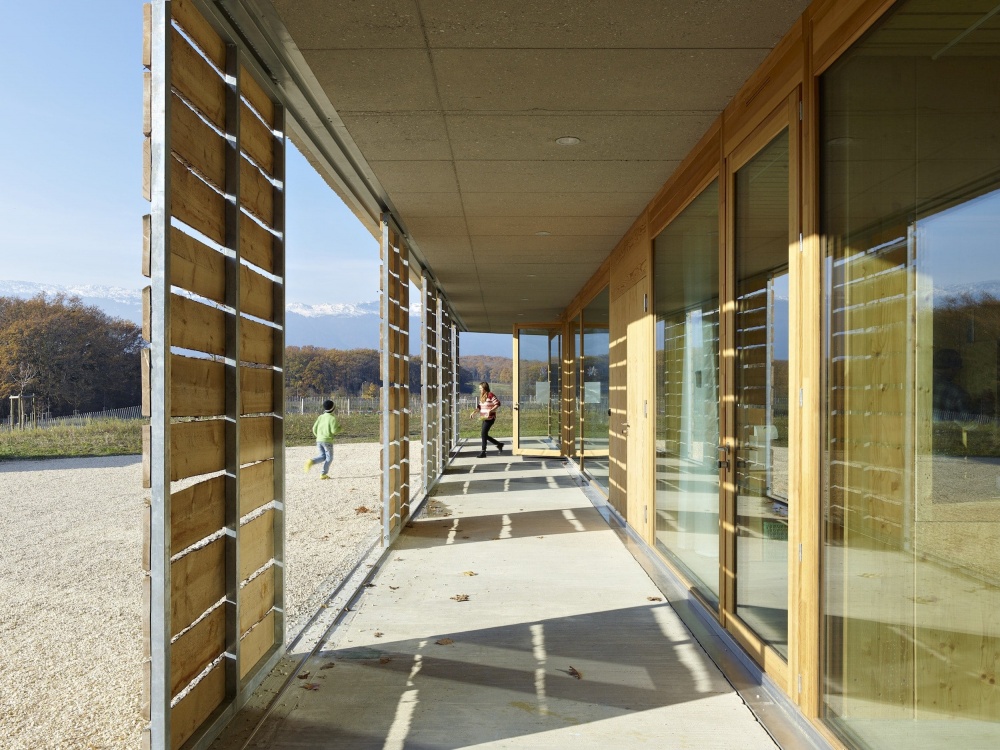
Unprogrammed and open to appropriation, intermediary space is one that enables the freedom required to play. What is freedom if not the opportunity to be irrational, irreverent, and –for once– unproductive? Play is the very appropriation and enactment of freedom. To play is to be free.
Building is serious business. Edifices are large, publicly visible structures that cost serious money and that must serve the purpose for which they were constructed, all while meeting the complicated legalities of zoning, building code, and energy efficiency requirements; not to mention the vicissitudes of the politics of neighbor and stakeholder participation. It is a miracle whenever a building is completed that on top of all the legal requirements and functional and political expectations contains a space that inspires play through architectural playfulness.
The work of CLR navigates the dialectics between structure and freedom —architecture and play— through the urban device of the unprogrammed intermediary space, creating opportunities for sociability, freedom, and free play.
- Patrick Longchamp, “Les Espaces de Transition” in 12 essais pour mieux construire Genève 01. Geneva: FAS, 2021, p. 60. “Par leur capacité à offrir un seuil entre la ville et l’habitat, [les espaces de transition] valorisent une échelle intermédiaire précieuse, qui adoucit la fracture juridique abrupte entre l’espace public et l’espace privé.” Translation by author. ↩︎
- Johan Huizinga, Homo Ludens: A Study of the Play-Element in Culture. London: Taylor & Francis, 1949, p. 132. ↩︎
- Ibid, p. 1. ↩︎
- Longchamp, op. cit., p. 63. ↩︎
 Criticalista