[Originally published in OnSite Review #48]
In the search for sustainable building materials, wood has come again to the fore. It is a natural material that is renewable (as long as the forests from which it is sourced are well-managed), that sequesters carbon dioxide (as long as buildings constructed of it are long-lasting), and has relatively recently become available in the form of much stronger and much more fire-resistant mass-timber products such as cross-laminated timber (CLT) and glue-laminated timber (GLT), allowing wood to be used as an alternative to concrete or steel.
Historically, architecture has undergone its greatest transformations whenever a new material or a new construction technique was discovered. The Gothic arch was an improvement of the Romanesque arch because it reduced the amount of buttressing needed, permitting more fenestration. In the nineteenth century, iron frame construction enabled greater structural capabilities and yet more fenestration, and early in the twentieth century reinforced concrete led to unprecedented plasticity. With new materials come innovative new forms, new building types and new expressions.
What innovations, then, are emerging out of the growing use of mass-timber? Two recently constructed buildings in Barcelona are illustrative in this regard. One is a sculptural, highly singular library by Suma Arquitectura; the other is a social housing block by Peris+Toral. Both of these constructions employ structural mass-timber. In the library this material was adapted to an architectural form, while in the housing block the material actively shaped the architectural form. Material follows form in one, whereas form follows material in the other, making for a compelling comparative analysis. Now, which project has led to an architectural innovation?
Bibliotèca Gabriel García Márquez
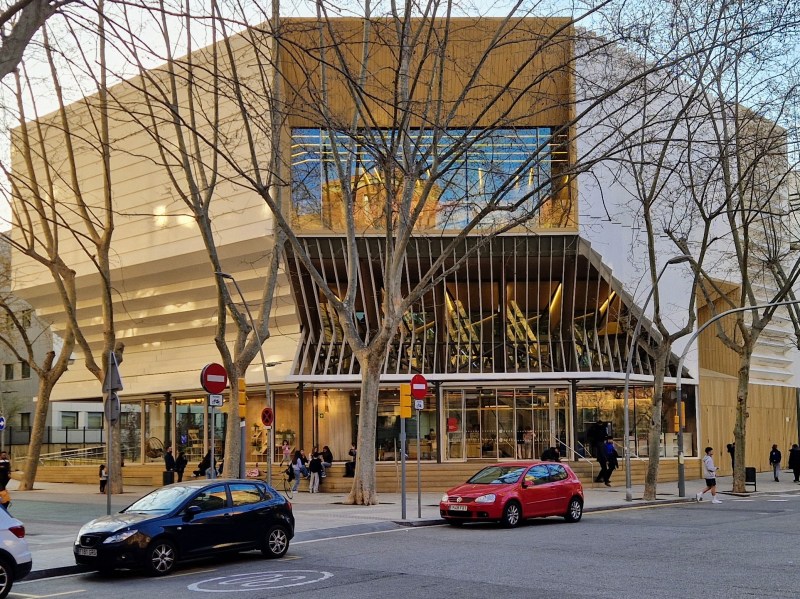
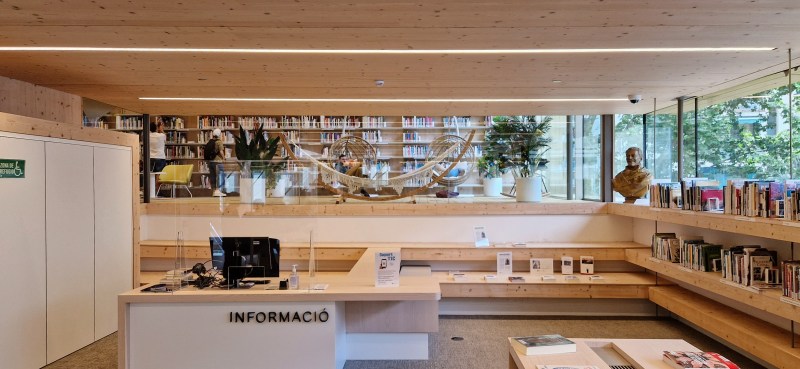
Bibliotèca Gabriel García Marquez is a neighborhood branch of Barcelona’s municipal library system. Situated on a chamfered corner of a typical city block, it is a very sculptural object-building characterized by immense glazed openings and an entire part of the building that is dramatically cantilevered over its entrance area. The library’s spaces step upward around a central skylit atrium in which mass-timber structural elements and connections are exposed throughout, creating a warm daylight-filled interior highly conducive to reading.
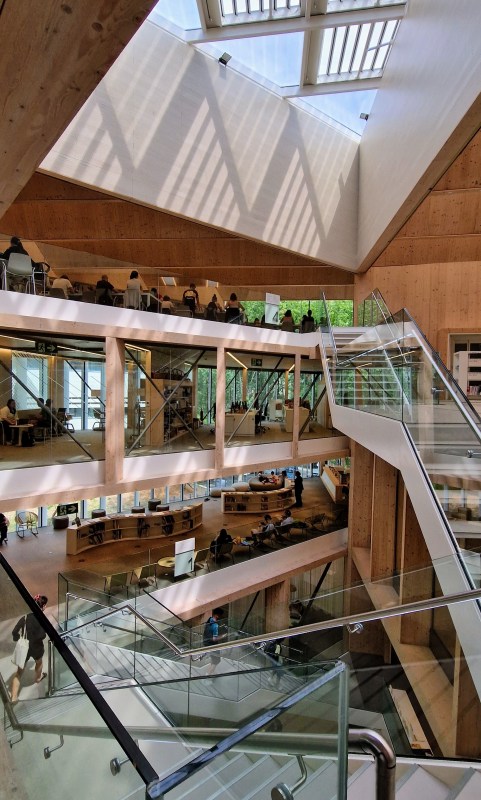
The interior spaces are varied in size and proportion, making for an eventful promenade while offering users plenty of choices in terms of places to work or hang out: there is a low-ceilinged area with children’s books, another area where small groups of teenagers do homework together, a media classroom where elderly people learn information technology, a lounge for reading periodicals, plus many stacks of books. There is something for every age group and social class in this bright and inviting public building.
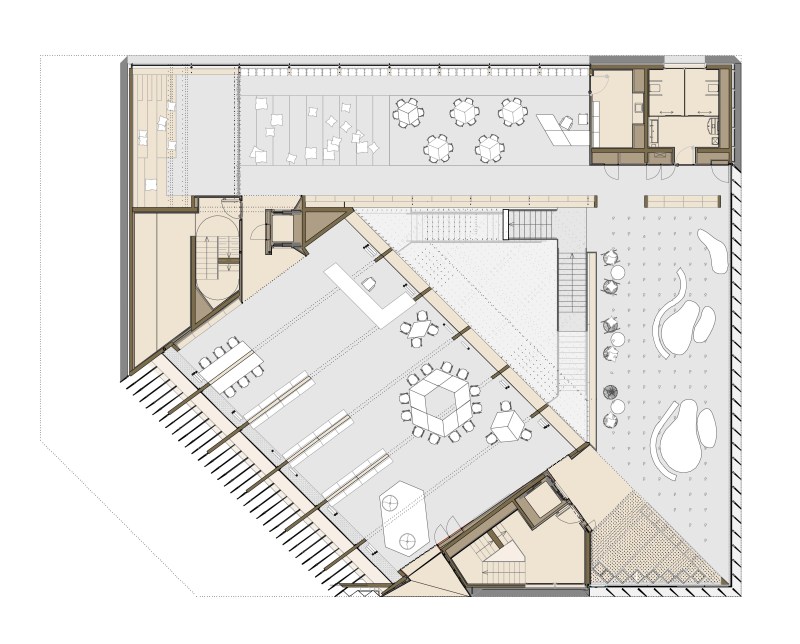
The architecture of the library, while delightful, contains little that is new. Despite its exciting and photogenic contemporary design, the Bibliotèca García Márquez is in essence a building in which a mass-timber structure happens to have been employed instead of steel or concrete. In fact, had traditional reinforced concrete been used, many of the large panes of glass might not have cracked, to say nothing of the cracks in the timber structure itself, which unfortunately has required steel pillars to be installed to support the sagging cantilever.
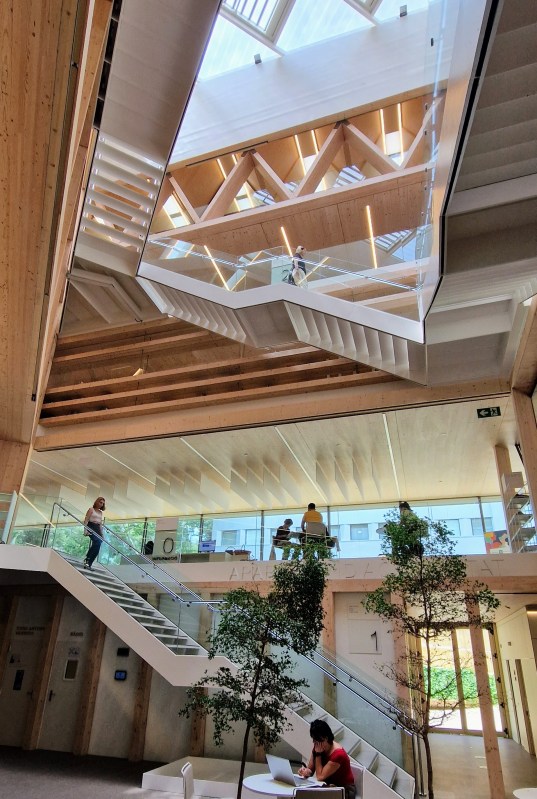
Mass-timber is more flexible than reinforced concrete, so it is perhaps not the ideal material for a building with large glass openings and a mighty cantilever full of heavy books. Bibliotèca Gabriel García Márquez reveals, then, a fundamental mismatch between its beautiful architectural form and its sustainable structural material.
Modulus Matrix
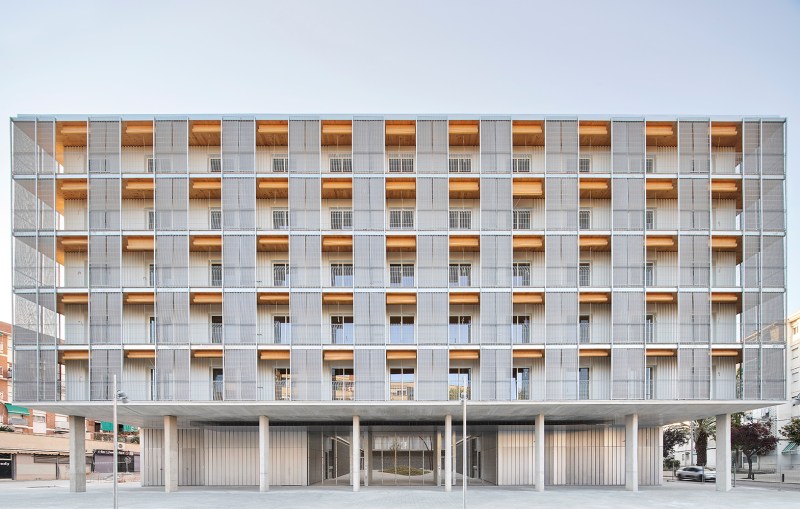
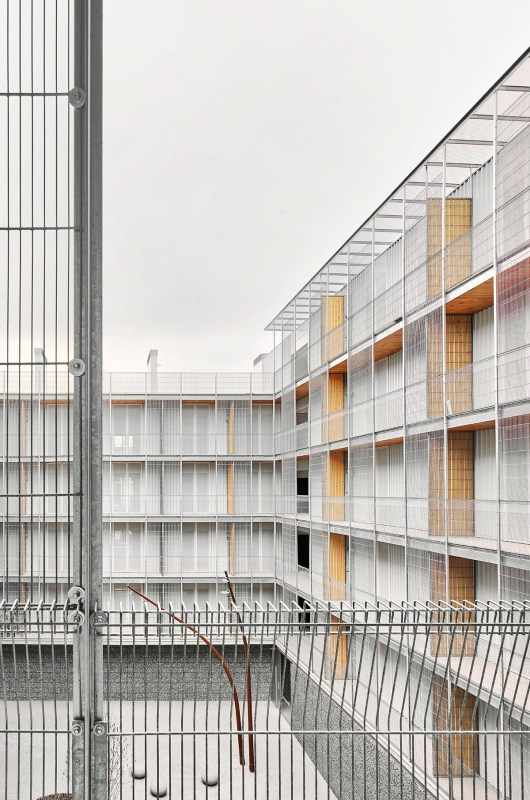
The residential complex Modulus Matrix is a much more generic mass-timber structure characterized by strict orthogonality, regularity and repetition. Organized around a central outdoor entrance courtyard whose four corners contain stair and elevator cores, the block’s floor plan is laid out on a nearly perfect 3.6m grid of rooms on every residential floor (the concrete basement and ground floor contain commercial uses). With rooms that are largely indistinguishable from one another, the floor plan makes it difficult to ascertain how residents reach their dwellings, or even where the separations between neighboring dwellings are situated (the only clues are openings between rooms). The gridded floor plan is truly enigmatic, inviting it to be solved much like a labyrinth in a puzzle book.
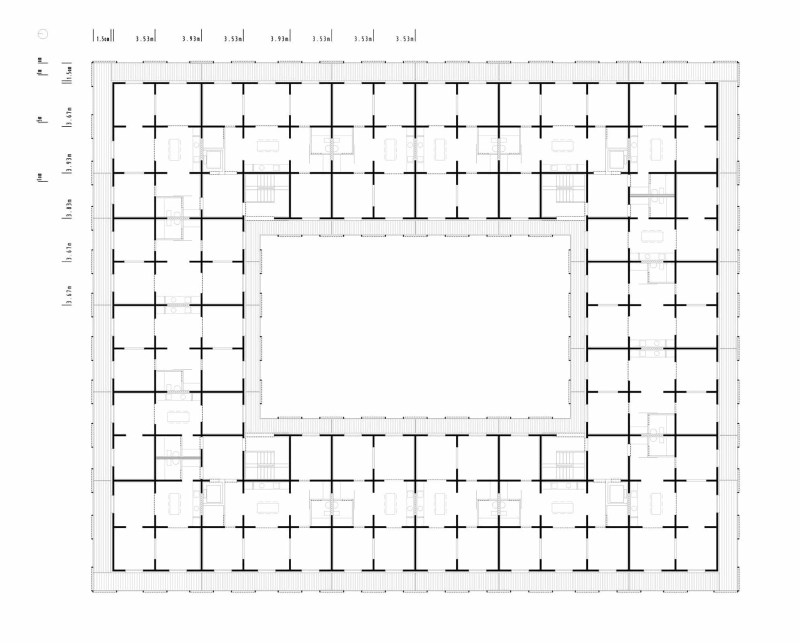
In the Modulus Matrix housing block, the structural material of mass-timber was the very starting point of its architectural design. More specifically, architects Peris+Toral began the architectural design process by determining and comparing the ideal structural spans of different thicknesses of CLT so that an optimized structural grid could be designed that best suits the given site and program. In Spain, CLT is relatively expensive compared to concrete and steel, putting it beyond reach of social housing budgets unless used very efficiently. The standardized, highly repetitive grid of Modulus Matrix is the product, then, of an affordability imperative.
The siting and program of Modulus Matrix were addressed after the design of an optimum structural grid, requiring very creative adaptations and inventions to make the building work. This process resulted in domestic ideas such as centrally situated dining rooms containing kitchens that provide access to similarly-sized generic rooms that can be used in multiple ways. In conjunction with large doors, these enfilades of rooms allow spaces to be joined up or separated; a significant reconfiguration of traditional apartments in which differently sized rooms following a strict functional hierarchy are typically situated along lengthy corridors.
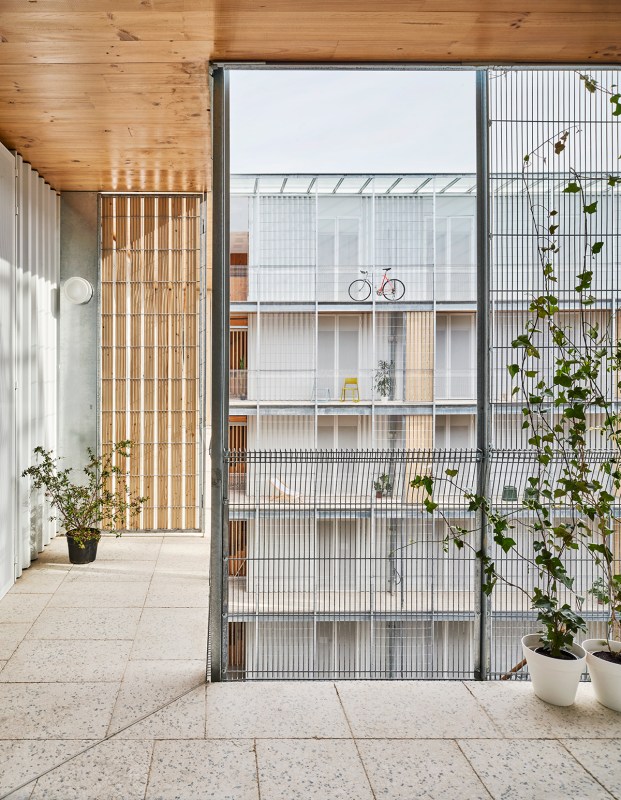
The predetermined structural grid of Modulus Matrix is precisely what gave rise to this domestic reconfiguration. Only rooms containing plumbing had their functions assigned: the eat-in kitchen and the bathroom. Most dwelling units contain three generic rooms, while some contain two and others four. A dwelling with three generic rooms can have a bedroom, a living room and an office in the case of a childless work-at-home couple; or two bedrooms and a living room in the case of a small family; or three bedrooms in the case of a household of roommates (is a living room really necessary when sharing an apartment with strangers?). Four generic room units offer even more diverse scenarios of inhabitation.
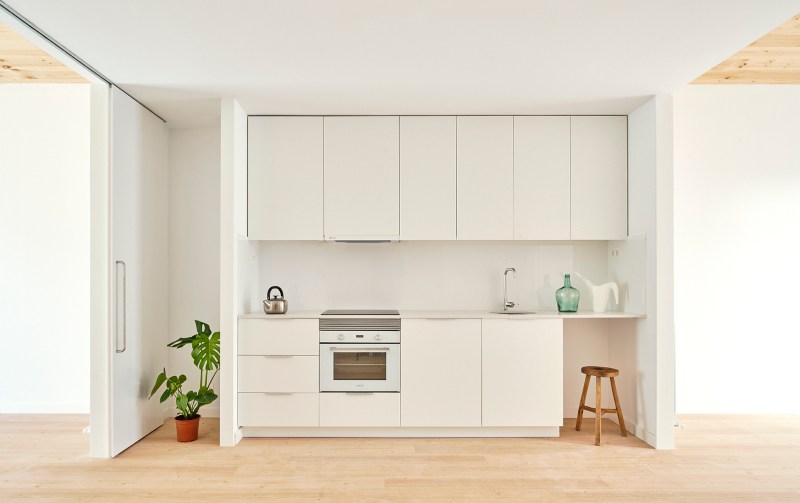
In Modulus Matrix, then, form follows material more than function. But this is entirely consistent with an epoch in which functional needs change whenever technology changes. In our online age, office buildings have become increasingly redundant while more than ever tiny secondary bedrooms are having to make do as home offices. At the same time, single-parent families are increasingly common, while the housing affordability crisis is forcing more people than ever to join together as roommates.
Conclusion
Buildings designed to satisfy exact functional needs become obsolete more quickly and are more complicated to adapt for reuse than generic buildings. Hopefully the beautiful library will not become obsolete any time soon, as it would be difficult to adapt to a new use. If construction – much of which follows demolition – emits nearly a third of all carbon emissions, then buildings need to be designed to be much more resilient to functional obsolescence. This suggests buildings that are more flexible and adaptable, and more durable and long-lasting if we also expect them to sequester carbon.
Such building longevity represents a complete turn-around from functionalism, when energy was plentiful and CIAM-inspired demolition in the name of “urban renewal” ensured modern architecture would always reflect the zeitgeist. The urgent need to reduce carbon emissions places the re-usability and longevity of materials at the forefront of architecture – and indeed just about every human activity – be they new materials or ancient materials assembled in new ways, as is the case with mass-timber. However, it is not enough just to replace one material with another. The architectural paradigm needs to be replaced as well.
 Criticalista
Interesting piece Raf. Interesting work. But, I went onto the architects website to see more and found that their drawings are ambiguous wrt to reading of structure. The perimeter walls are clt but they are drawn as if there are structural clt walls on a 3.6m x 7,2m grid (with gyproc infill on the 3.6m grid) that is perpendicular to the perimeter walls. However, their construction photos show that there are no perpendicular clt walls and that there are wood posts on the 7.2m grid. When I see this it seems that the drawings on their website may have been their original scheme wherein the perpendicular clt walls were later value engineered out. I would think therefore that they show their original drawings because it is more conceptually didactic than what was built… all best, h
You are very observant! The CLT walls were indeed value-engineered out, as it was more cost-efficient to use GLT posts and beams. But the floors and exterior walls remained CLT.
PS. As of last year, 18 storey mass timber buildings are now doable in Qc…