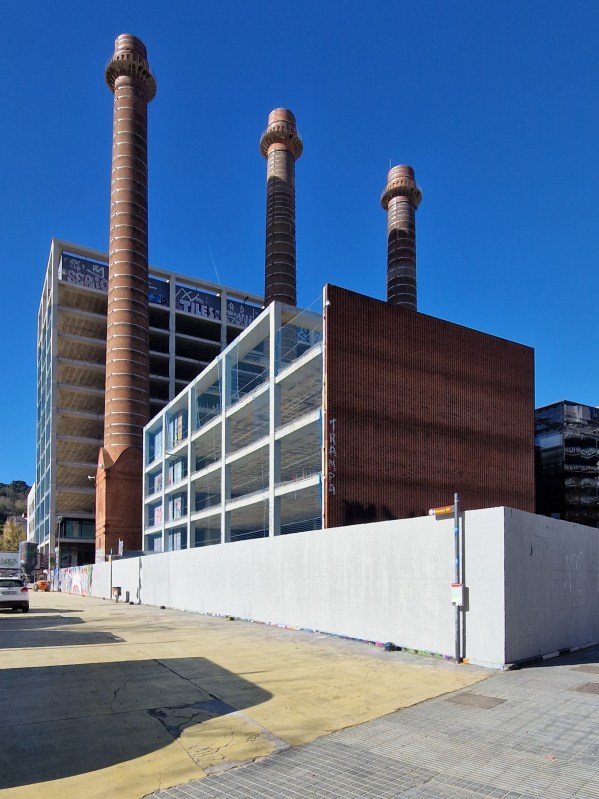
Like many of Barcelona’s public spaces, Jardins de les Tres Xemeneies (Gardens of the Three Chimneys) is a former industrial site that has been repurposed. Named after three 72m tall brick chimneys that are the only remainders of Spain’s first (Europe’s 3rd, and the world’s 7th) electrical power generating plant, the site is also known as La Canadenca (the Canadian) due to the financing of its construction by the Canadian Imperial Bank of Commerce. In 1919, a workers’ strike at La Canadenca grew into a nationwide general strike lasting 44 days and resulting in the 8-hour workday being written into Spanish law. The coal-burning plant eventually stopped working in the 1970s and was demolished in 1987 to be replaced by an office building for the Spanish electrical company. The three chimneys form a sort of classical colonnade in front of the office building, which has been empty for several years while awaiting renovation by a new owner. In the interim, the entire curtain wall of the building was removed –leaving only the concrete structure– just to prevent squatters from settling in.
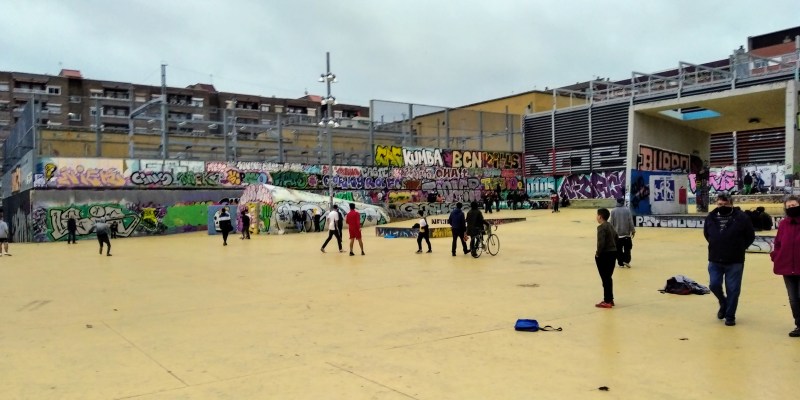
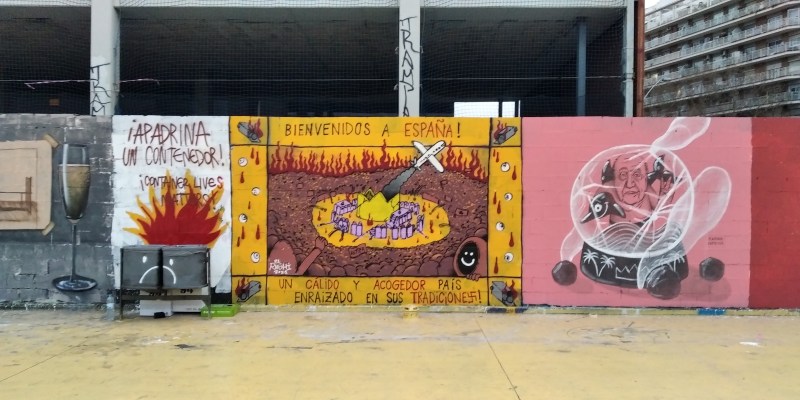
The empty office building is separated from the neighboring public space by a long utilitarian concrete-block wall that has attracted graffiti artists for many years. The garden’s many hard surfaces –all graffiti-covered– also attracts skateboarders to the area, along with break-dancers and kids playing basketball, converting it into one of the most dynamic public spaces in Barcelona; a space with youthful music, murals, sport, and dance.
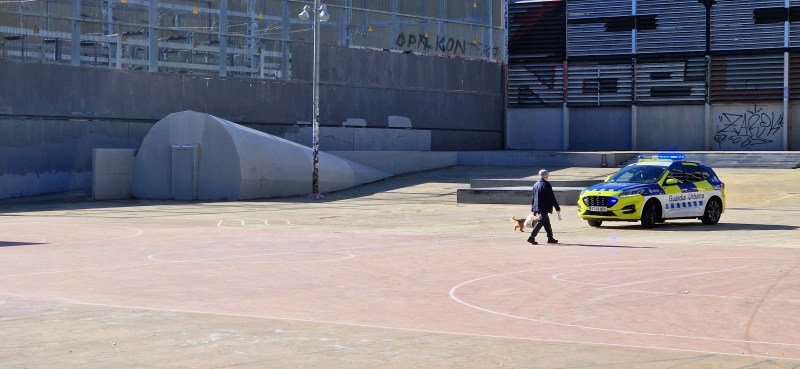
Until recently. One day earlier this month a crew of city workers showed up and –guarded by police– proceeded to paint almost all the graffiti-covered walls grey. The police even stayed behind to make sure these surfaces remain grey. A Guardia Urbana patrol car seems to be permanently parked in the middle of a skateboarding ramp to prevent any of the activity that once made this space lively and colorful. The garden is now a depressing grey color throughout, with only the occasional dog-walker to be seen. What’s going on?
The city’s mayor, Jaume Collboni, has initiated a crack-down on graffiti, skateboarding, drinking in public, and other activities he considers uncivic. Hefty fines are now issued for incivisme as part of City Council’s Pla Endreça, which translates as “clean-up plan.” Even tour guides showing what remains of any graffiti can be fined (!). Meanwhile, professional pick-pockets continue to ply their trade in the city (the other evening in a bar a thief made off with a mobile phone belonging to a friend).
The whole idea behind Pla Endreça is, I suspect, to transform Barcelona into a “classier” tourism destination. Over-tourism has become a serious problem, and attracting “quality” tourists, a euphemism for big spenders, has long been on the agenda of the city’s business community. The idea is to encourage the kinds of tourists who come to stay in 5-star hotels, eat in Michelin-star restaurants, and see works by starchitects while discouraging the kind who come to share cheap AirBnBs, eat in cheap dives, and smoke cheap dope.
Barcelona has long been a city of extreme inequality. While the bourgeoisie competed to build the finest modernista houses on Passeig de Gràcia at the turn of the 19th to the 20th century, the city’s working class, living in overcrowded rooms adjacent to factories, had an average life expectancy of only 27 years. Two films, Vicky Cristina Barcelona (Woody Allen) and Biutiful (Alejandro González Iñárritu), both starring Javier Bardem, illustrate the city’s inequality perfectly. City Council funded the production of Vicky Cristina Barcelona to the tune of 1 million euros –under the condition that the word “Barcelona” appear in the title– whereas Biutiful received considerably less Council funding, which speaks volumes.
Turning a city into a playground for the rich is cultural suicide. Just look at New York or London, cities that decades ago had vibrant music and art scenes but are today sanitized, boring and expensive. Why are so many cities following this staid model? Cities need spaces and places where home-grown creativity can flourish. High culture has always looked to street culture for inspiration.
The irony is that Pla Endreça is not even working, as clean-up crews cannot keep up with the amount of trash that is illegally dumped on countless side-streets. Much of this trash comes from illegal renovations, as the city has made obtaining a building permit so insanely cumbersome and complicated over the years that many property owners don’t waste their time applying. The filthy rich produce much more trash than the rest of us, and yet cities want to cater to this more wasteful collective by cleaning up street culture?
Of course, graffiti that defaces buildings should rightly be fined. But painting temporary concrete-block walls does nobody any harm. On the contrary.
 Criticalista