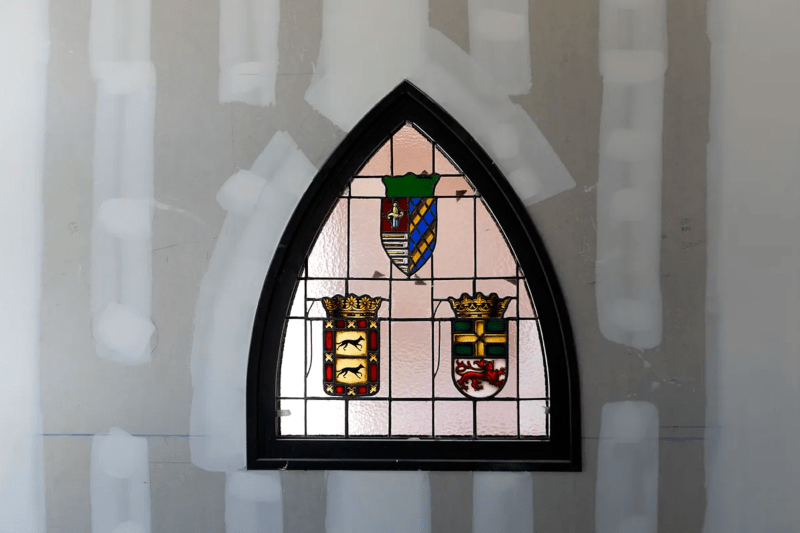
A new university campus has just been inaugurated in Madrid that manages to be both out of place and out of time. The Instituto de Estudios Bursátiles (IEB), also known as the Institute for Market Studies, is a new construction sited high atop a hill in suburban Aravaca. Enjoying privileged views of metropolitan Madrid’s sprawl and its business district in the distance, the campus has been constructed in an English neo-Tudor style. It has the massing of a Medieval castle, neo-Gothic windows, dormers galore, and a Christian cross over the main entrance. Thing is, this is not Medieval England. Nor is it 21st-century USA, in which case it can be seen to resemble a “McMansion hell” monster home. No, this is Castille, in Spain. What is this neo-trad Anglo-Saxon architecture doing in the land of Don Quixote, coño!?
It is quite obvious that the IEB’s architecture attempts to make references to Oxbridge, which so many other university campuses have historically been inspired by in the Anglo-Saxon world. But why in Spain, where the beautiful University of Salamanca, one of the oldest universities in the world, right up there with Oxford and Cambridge, would have served as an arguably more appropriate historical reference? And as always with references, the idea is not to reproduce them literally but to reinterpret them, thereby adapting them to changing times and keeping them alive.
There’s another disturbing issue here. The interior of the building is very modern. It has air conditioning, high-speed internet, large column-free spaces, mezzanines with laminated tempered glass balustrades that conform with the building code. Isn’t this completely out of sync with the neo-trad exterior? Is it another example of “everyday camouflage”? It is certainly intended to give off an impression distinct from its modern, highly technological educational programme, but it doesn’t work as camouflage because probably no other building in all of Madrid –The European Union’s second-largest metropolis— even comes close to resembling this architectonic abomination. The whole point behind camouflage is to blend-in with surroundings, yet this sticks out like a sore thumb.
Alright, so the client wanted to recreate Oxbridge. England is, after all, where capitalism was first theorized. An Oxbridge style campus doesn’t look very different from many of those US university campuses that international students are now avoiding like the plague ever since Trump sent his “Gazpacho police” to hunt-down and imprison foreigners. So as far as siphoning international students away from the US universities is concerned, this architectural strategy might seem to make a bit of sense. It might even work on students applying from China. But if that’s the intention, then a neo-Salamanca style campus would still be more effective. Salamanca is known around the world too, especially for its riotous student street parties.
But why imitate historical styles at all? Shouldn’t architecture reflect its time? The same question could be asked about the imitation of futuristic styles, of course: why imitate “The Jetsons,” señor Calatrava? Why imitate a space station, senyor Ruiz-Geli? Spain is often cited as possessing building cultures that appreciate the importance of being rooted in both place and time. But this building is neither Castille nor 21st-century.
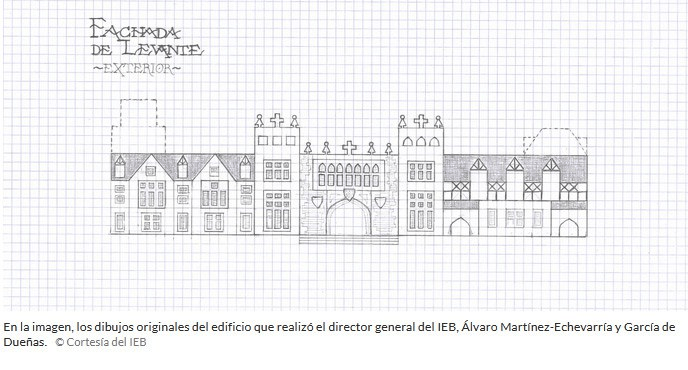
You might well be asking by this point: just which architect designed this horrorshow? Well, according to an article in El Mundo titled “The Gothic Renaissance of IEB: ‘We are classic on the outside, but avant-garde on the inside’,” it turns out this campus was designed by its very client, the director of the institution. The name of the architect of record, the one who filled in reams of paperwork and is legally responsible for 10 years, is nowhere to be found in any of the media articles covering the inauguration of this building.

Undoubtedly, many people will love this building and admire its historicity. They will say it is “unique,” that it has “character,” and that is it unlike so many “ugly concrete boxes designed by architects.” And they will not be the least bit incorrect in saying so. But buildings of this scale, expense, and publicness –it is an educational institution!– cannot be left to amateur designers, even if some architect assumes legal responsibility. If this were a cabin in the woods there would be no issue. Public buildings in Europe must legally go through a public competition process for a reason. Of course, a public competition and selection process is not always a guarantee of architectural quality either, but then at least the fault is more societal and political. How was the new IEB campus able to evade an official architectural competition process? Was it built without any public funding? Is this the future of right-wing privatization? If so, God help us.
 Criticalista