
It’s finally happening. A commercial thoroughfare in my neighborhood that is much too narrow, traffic-laden, and overcrowded with shoppers is finally in the process of getting pedestrianized, thanks to pressure from local residents, myself included. With sidewalks that are barely 1m wide and a narrow, single-lane roadway that is constantly occupied by cars, trucks, and motorcycles moving at a snail’s pace while spewing exhaust fumes, Barcelona’s Carrer de Sant Antoni Abat has long been one of those streets where you have to hold your breath and quicken your walking pace. It was a veritable traffic sewer until its recent closure for construction work.
One of this street’s peculiarities is that its roadway –which will soon be levelled with the sidewalk– has a kerb that is no less than 20 cm high, making it impossible for wheelchair users and difficult for elderly persons to navigate. Add to that the hordes of delivery personnel with trolleys stacked to the heavens constantly taking up the entire sidewalk width, and you have “a highly contested urban space.” Sounds super-cool, except here contestations sometimes resulted in violence.
Sant Antoni Abat is one of the oldest streets in Barcelona. It was originally an ancient Roman road (a segment of the Via Augusta, no less) connecting the southwestern gate and Cardo axis of Barcino (Barcelona as it was known then) with the provincial capital Tarraco (Tarragona) and the rest of Hispania. Centuries later, when Barcelona’s Medieval walls were expanded starting in the 14th century to create El Raval (“the suburb”), this road received a city gate dedicated to Saint Anthony, together with a rampart from which this new entrance could be guarded. The 1714 capitulation of Barcelona to Bourbon troops at the end of the War of the Spanish Succession was signed at this very gate, in a stone house that still survives to this day on this dingy street.
As this part of El Raval grew and densified (to more than 800 persons per hectare!) during the industrial revolution, Sant Antoni Abat street became the busy commercial axis it is today. When the defensive wall surrounding Barcelona was finally demolished and Ildefons Cerdà’s famous Eixample expansion plan of 1859 was implemented, the Sant Antoni market –Barcelona’s largest– was one of the first public buildings to be completed in this new part of the city. Today it’s possible to see the excavated ruins of the former rampart in the lower level of the market.
The ripping up of Sant Antoni Abat’s asphalt is music to my ears. No more narrow sidewalks, as stone pavement will now stretch smoothly from building facade to building facade. Vehicular traffic –which is not being banished outright, only discouraged– will now have to respect pedestrians rather than the other way around. Wheelchair users will now be able to navigate this street, and those pushing strollers or delivery trolleys will now have sufficient room to maneuver.
Narrow Medieval streets simply cannot have kerbs, let alone ones that are 20 cm high. City Council long ago levelled the narrow streets of old Barcelona, but for political reasons this one, the worst of them all in terms of traffic, was never touched. Until now, that is, thanks to a really great and feisty bunch of neighbors who fought tooth and nail for this change to happen.
Why has it taken this long for a street this busy and inhumane to finally get some much-needed improvements? Hard as it may be to believe, there were fierce opponents to the levelling up of this street. Concerns over gentrification were aired by opponents on the left, while fears of not being able to drive on the street at all anymore were aired by opponents on the right, resulting in a political hot potato. Is it reasonable to fight gentrification by forcing residents to suffer from a lack of personal safety and high levels of air and noise pollution? No, gentrification has to be fought by introducing laws that protect rents and by building an adequate supply of social housing. Similarly, is it reasonable to insist on a supposed right to drive anywhere in your private vehicle in a city center as dense as Barcelona’s, where motor vehicles take up an inordinate amount of contested urban space? No, the private automobile can simply no longer be the sole criterion around which urban space decisions are taken. Those days are simply over (BTW I say this as a co-owner of an automobile!).
I’m so looking forward to calmly strolling down the middle of this street when this highly contested urban space reopens as a highly improved urban space.
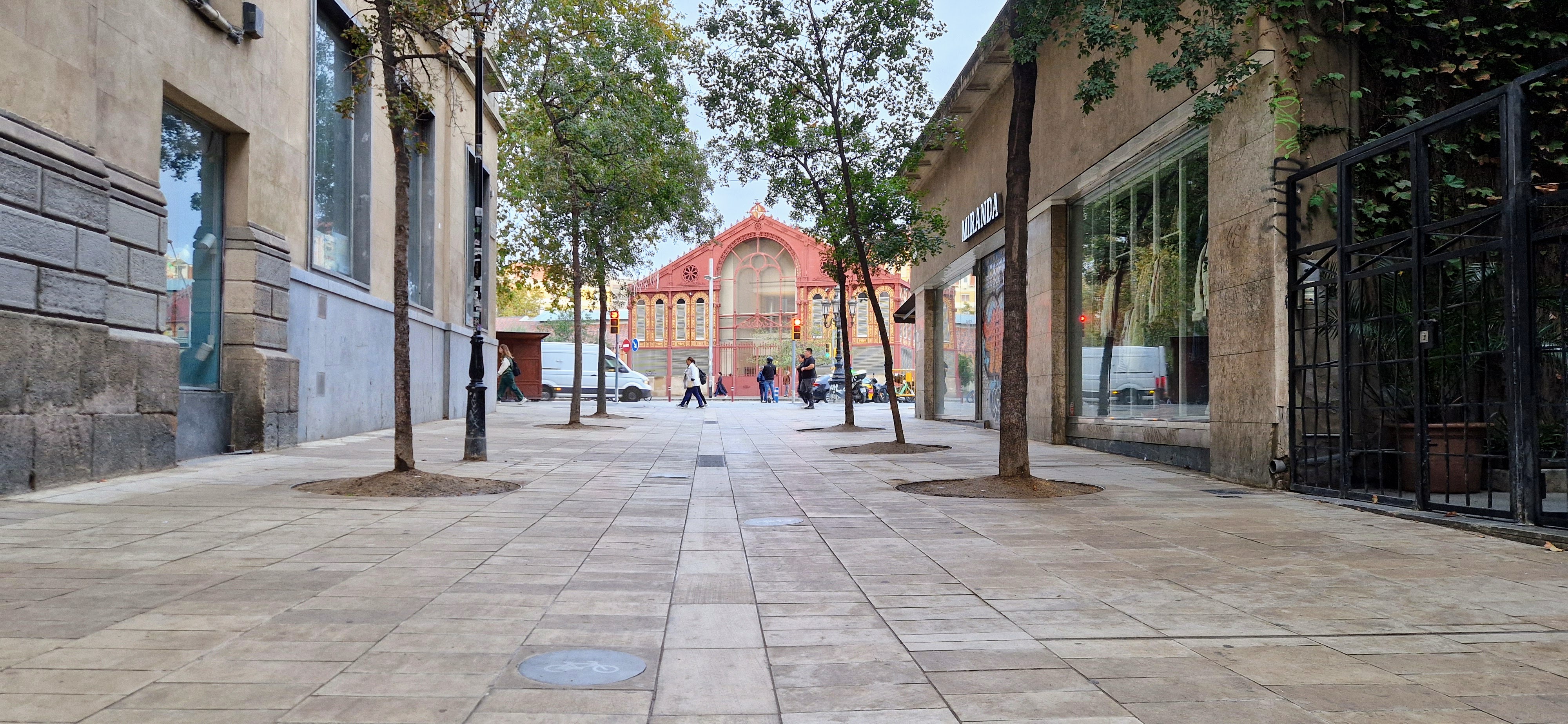
POSTSCRIPT: Here is how Sant Antoni Abat Street looks today. By eliminating the curb, and paving the entire roadway uniformly, pedestrians now have the right of way over motor traffic (which can still circulate).
 Criticalista
Any actions planned to address the crime rate on the street and about the constant loiters and noise disturbance they bring with them?
Especially around the square space before Teatre de Raval intersected with Carrer d`en Sant Climent. It’s every day noise disturbance by the same crowd of people.
That is a policing issue. Call 112 and complain