[Last December, Bauwelt Magazine asked their contributors to send them a postcard from their hometown along with a new year’s greeting addressing a current issue. A somewhat longer, more in-depth article to accompany images of the postcard was also commissioned]
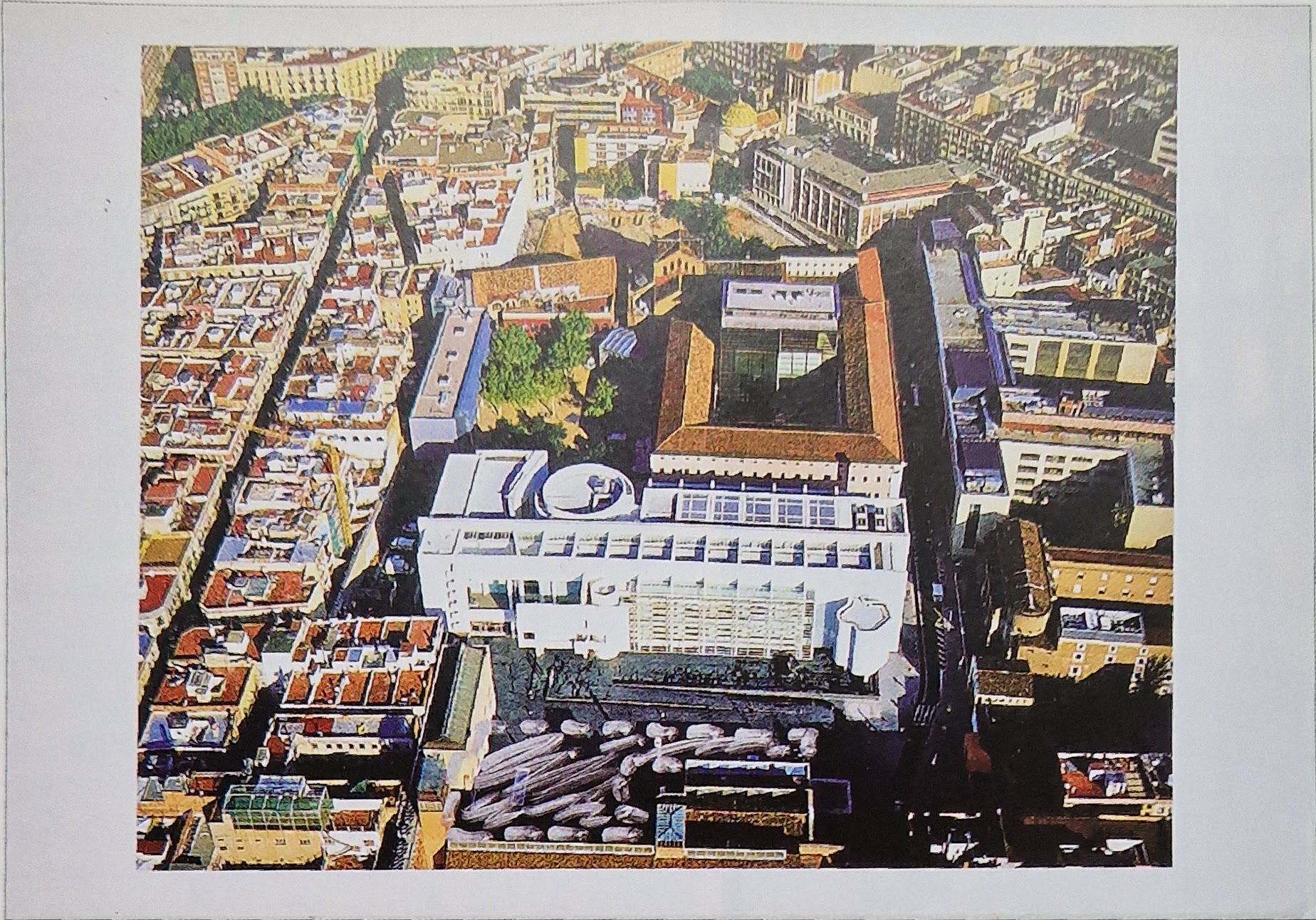
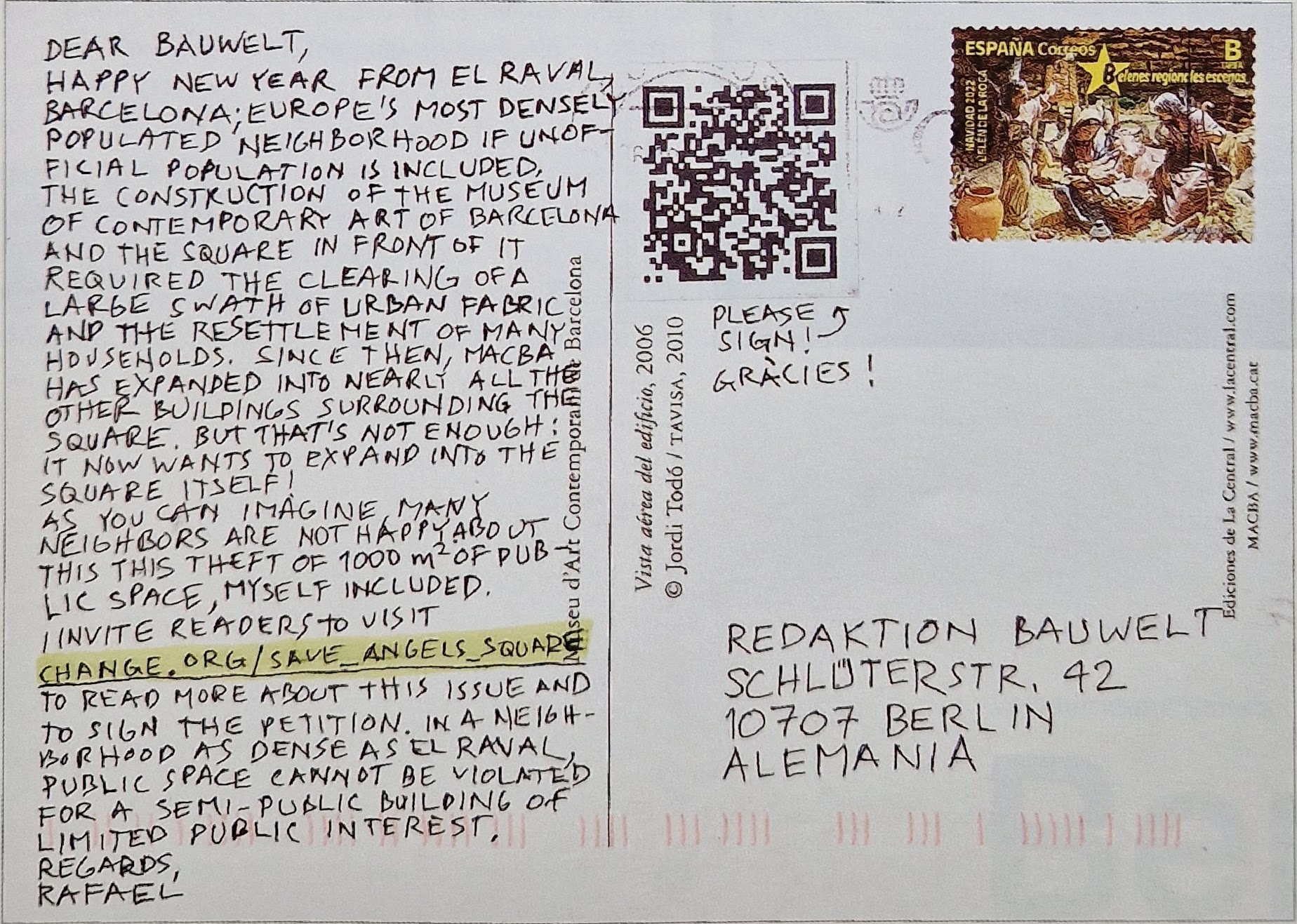
Happy new year from El Raval, Barcelona; Europe’s most densely populated neighborhood if unofficial population is included. The picture on the front of this postcard is the Museum of Contemporary Art of Barcelona, or MACBA, one of several cultural institutions situated in El Raval. Designed by Richard Meier (can you tell?) and inaugurated in 1995, its construction required the demolition of a large piece of urban fabric and the resettlement of many households. Since then, MACBA has expanded into nearly all the remaining buildings surrounding the square. But that is not enough: it now wants to expand into a part of the public square itself. As you can imagine, many neighbors are not too happy about this theft of nearly 1000 m2 of public space, myself included. I invite readers to sign a petition against MACBA expansion at change.org/Save_Angels_Square. In a neighborhood as dense as El Raval, public space cannot be sacrificed to build a semi-private building of limited public interest.
The Plaça dels Àngels square is worth a visit. The MACBA plinth has become a global skateboarding mecca, attracting pros, fans, and 24-hour party people from all over the world. Unfortunately, however, the square is used little by neighbors, who would prefer a playground, trees, and benches to so much stone. It is the quintessential “hard square” unanimously disliked by non-architects.
Needless to say, the square has become highly contested. But contestation and rebellion have a long tradition in El Raval, the beginnings of which date to the third expansion of Barcelona’s old city walls in the 15th century. During the late 19th and early 20th century, El Raval became a working-class neighborhood inhabited by immigrants from the rest of Spain as well as a bohemian quarter of prostitution, drugs, and gambling. Its resemblance to San Francisco’s Chinatown earned it the popular name “El Barrio Chino”. In the 1980s, it became the center of Barcelona’s heroin trade, developing a reputation as a “dangerous neighborhood.” This changed with the arrival of the 1992 Olympic Games to the city, when the area was largely cleaned up for the benefit of tourists. Today, it is a diverse neighborhood of immigrants from the global south, Erasmus students, hipsters, and visitors, and is badly affected by gentrification, over-tourism, degradation, poverty, and homelessness.
Situated just behind the MACBA are two fascinating buildings: the Contemporary Cultural Center of Barcelona (CCCB), an adaptive reuse of the old charity hospital completed in 1994 by Viaplana & Piñon; as well as the anti-tuberculosis clinic, an early modernist building from the mid-1930s by the GATCPAC, Spain’s first avant-garde architects. Also be sure to visit Palau Güell, a beautiful early work by Antoni Gaudí situated just off Las Ramblas.
To learn more about El Raval and Barcelona, I recommend the book Barcelona by Robert Hughes, a very amusing but also insightful history of the city. If you’re hungry from all the walking around, go to Bar Muy Buenas at Carrer del Carme 63 for classic Catalan cuisine in a Modernista interior, or Arume on Carrer d’en Botella 11 for Galician fusion cuisine. Bon profit!
 Criticalista
1 Comment