[Originally published in The Architectural Review December / January 2026]
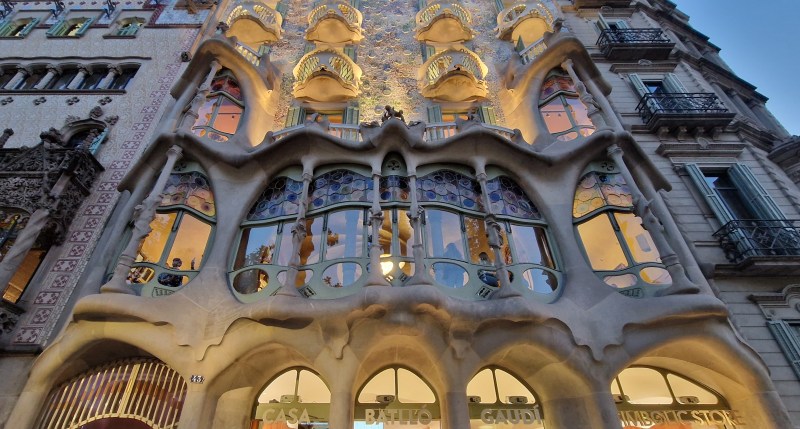
The year 2026 marks 100 years since the death of Antoni Gaudí, who died in a Barcelona hospital after being struck by a tram. Gaudí’s buildings are being feverishly fixed up for the occasion, among them Casa Batlló, which has recently undergone a fresh raft of restorations as part of an ambitious ongoing programme of refurbishment.
Completed in 1906, Casa Batlló was not built anew, but was a radical renovation of a multi‑residential building constructed in 1877 by the architect Emili Sala Cortés, one of Gaudí’s professors, in accordance with Ildefons Cerdà’s 1859 Eixample urban plan (AR February 2025). Imposed by the Spanish army, Cerdà’s plan was abhorred by many Catalans at the time; its orthogonal street grid carried colonialist overtones that were insulting to Catalan nationalists such as Gaudí. Cerdà may have employed his grid for reasons of egalitarianism rather than colonialism, but his utopian‑socialist ideology did not suit the Catholic and ultra‑conservative Gaudí either.
By the end of the 19th century, the Eixample’s Passeig de Gràcia had become Barcelona’s most fashionable boulevard for the wealthiest bourgeois families. As Michael Eaude writes in his insightful 2024 book Antoni Gaudí, the city’s wealthy industrialists ‘united to combat the anarchist‑led working class, but fought with each other to build the finest house on the street’. A fierce rivalry started in 1898, when the chocolatier Antoni Amatller hired architect Josep Puig i Cadafalch to reform a building at Passeig de Gràcia 41, which Puig did by adding a Flemish stepped gable and lavish neo‑gothic ornament. This provoked Francesca Morera just a few doors away to hire architect Lluís Domènech i Montaner in 1902 to renovate a building she had inherited, in this case in a florid Catalan art nouveau style. Textile industrialist Josep Batlló, owner of the house adjacent to Casa Amatller, then hired Gaudí in 1904 to put the others to shame. The resulting clash of styles earned this city block the nickname illa de la discòrdia (block of discord). […]
[Please continue reading at The Architectural Review]
 Criticalista