
Antoni Gaudí is often cited as an architect who was “in tune with nature.” His complex, curvilinear forms, it is often said, were “inspired” by nature, paying homage to it in return. Today, countless architects cite natural phenomena such as crystals, rivers, mountains, deserts, and vegetation –especially trees– as the inspiration behind complex architectural forms.
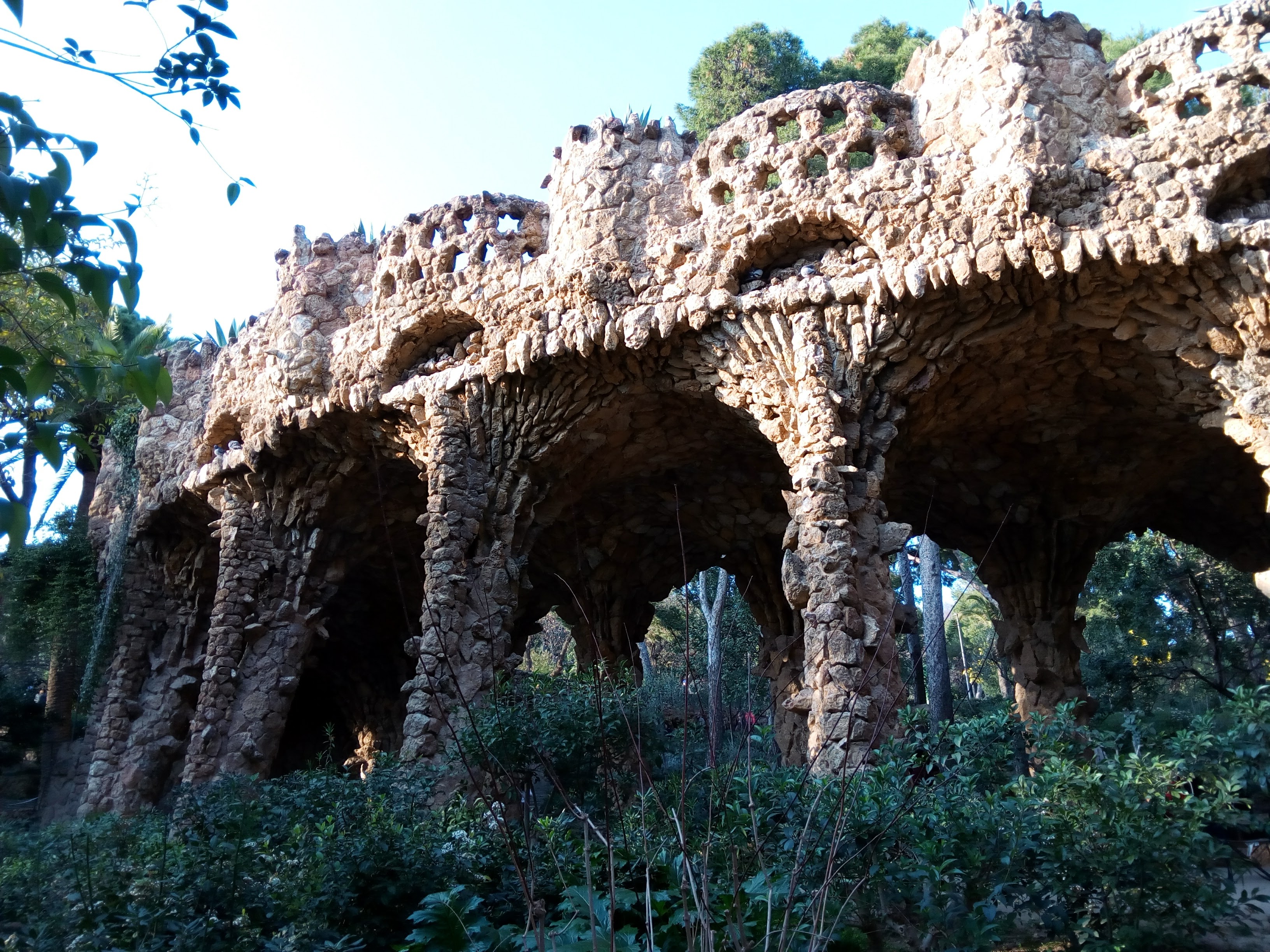
But Gaudí’s architecture is not “close to nature” just because many of his designs resemble it. This is an overly superficial, formalist, and simplistic interpretation of his work. In fact, what Gaudí sought most was for architecture to be based upon natural principles that respect and value nature, not merely imitate its forms. This is why, for example, at Park Güell, which was originally intended to be an exclusive residential community (influenced by the ideas of Ebenezer Howard and his Garden City), he had every tree on the site surveyed before laying out the serpentine road pattern, so that as many trees as possible could be maintained. Instead of navigating the steep terrain using rock cuts, he preferred to construct rustic stone viaducts, which enable the natural topography and vegetation to be maintained.
To determine the most efficient structural geometry for Colònia Güell crypt and the Sagrada Familia temple, Gaudí developed a highly unique method that uses gravity, a natural force. His polyfunicular models made of hanging chains generate catenary arches that require no buttressing, and so are highly efficient; an improvement of Gothic arches (themselves an improvement of Romanesque arches). Compare this attitude with that of many contemporary architects who design buildings with bold cantilevers in defiance of gravity.
Gaudí sought to make highly efficient use of building materials precisely because these are made with raw materials extracted from nature. In fact, he also upcycled scrap materials and byproducts from industry. The beautiful balcony railings of Casa Milà / La Pedrera are made of scrap iron, as betrayed by the flattened lengths of angle iron and the many rivet holes. Each balcony railing is unique; a work of abstract art long before other artists started making sculptures out of scrap metal.
It is known that the trencadís mosaics made from broken tile shards at Park Güell’s serpentine bench and the façade of Casa Batlló were collected from the dumpsters of other construction sites. Indeed, Casa Batlló itself is a refurbishment of a pre-existing building that the client originally insisted on demolishing. Gaudí convinced Batlló not to replace his house with a new one, arguing it was wiser to transform it instead. This was an entire century before Lacaton & Vassal’s “Never Demolish” manifesto. At the Güell Colony Crypt, Gaudí even used slag from industrial furnaces, a byproduct that normally ends up in landfill sites, as well as deformed bricks rejected from a brickyard. Oh, Gaudí was also vegetarian, by the way.
In the end, what Gaudí displays is an economy of means, precisely out of a profound, indeed religious respect for the natural environment. He rejected the idea of modernity as triumphant over nature; an idea that is unfortunately still prevalent today. If he could see The Line being built today in Saudi Arabia he would surely be disgusted.
 Criticalista
awesome – thank you!