[Originally published in Bauwelt 8.2026]
It’s official: Antoni Gaudí is now certified to be the architect of Xalet de Catllaràs, a remote mountain hut situated high in the forested foothills of the Catalan Pyrenees. Although this has long been rumored to be the case among locals, no documents have ever been uncovered providing definitive proof, and so in 2023 –only a few years before the centenary of Gaudí’s 1926 death– the Generalitat de Catalunya (Catalan government) hired the Càtedra Gaudí, a research unit of the Polytechnical University of Catalunya directed by Galdric Santana Roma, to investigate.
Built between 1901 and 1903 by Eusebi Güell, Gaudí’s most important patron, the hut was intended to accommodate engineers opening up nearby coal mines with which to fuel a cement plant. Gaudí was always believed to be the architect of the Xalet because of its catenary vaulted form, his close association with Eusebi Güell, and also because he completed a garden near La Poble de Lillet in 1906 for textile magnate Joan Artigas. Furthermore, in a 1946 article in the magazine Cortijos y rascacielos, Domènec Sugrañes, a former collaborator of Gaudí’s, is cited stating that Gaudí was the architect of the hut. Rather uncharacteristically, Gaudí never supervised construction of this project, probably owing to its remoteness. This means, of course, that his design may have been modified on-site, leading him perhaps to dissociate himself from the project.
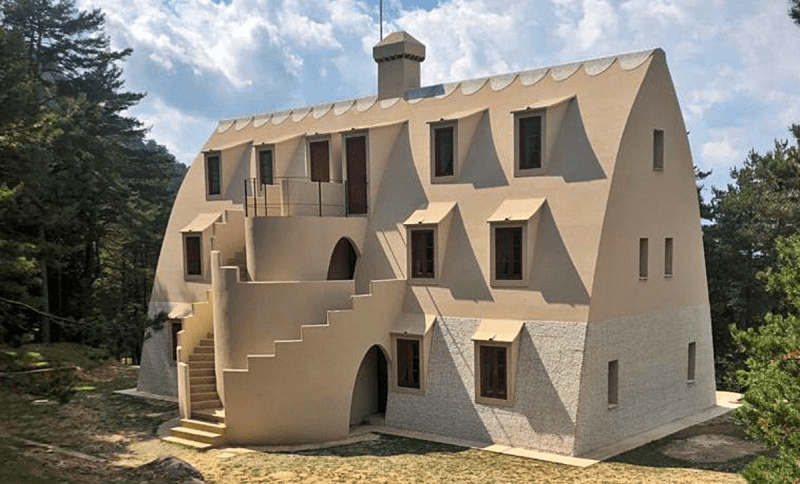
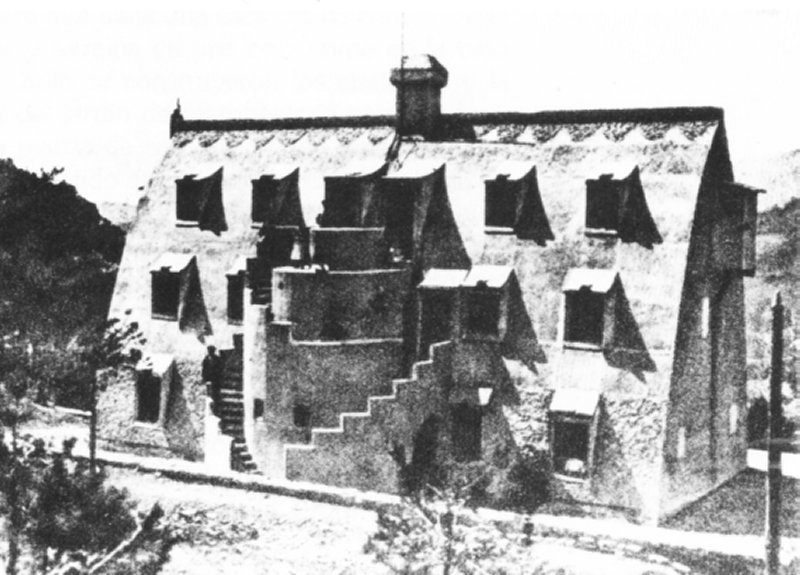
Situated on a mountain-side at an altitude of 1371m along a dirt road 12 km from La Pobla de Lillet, the hut occupies a forest clearing far from civilization. Its form is essentially a tall catenary vault containing three rectangular floors that diminish in size toward the top. The ground floor contains a kitchen and dining room as well as two apartments for accommodating staff while the upper two floors, reached by an exterior stair, contain two apartments each. The exterior circular stair tower is one of the building’s most remarkable elements. It consists of a pair of curved symmetrical stairs that lead to a first-floor landing, from which a single helical stair continues to the second-floor landing.
The stair notwithstanding, Xalet de Catllaràs is one of Gaudí’s simplest and most economical designs, revealing that he was very capable of adapting to topographical and climatic conditions very different from Barcelona’s. Gaudí was of course known to revere nature and to embellish his buildings with ornamentation and elements referencing flora and fauna. Here, about as deeply submerged in nature as it is possible to be in southern Europe, Gaudí has no need to represent nature figuratively. El Xalet de Catllaràs is Gaudí’s most minimalist, ornament-free work.
In 1932, the Xalet was ceded to the municipality of La Pobla de Lillet, and in 1971, after a lengthy period of abandonment and degradation, it was converted into a children’s summer camp. In 1989 the building was again abandoned until 2015, when the latest restoration project was begun.
The illustrated 85-page report by Santana Roma focuses on the Xalet’s geometry, structural system, construction technique, and functional layout, concluding that there are sufficient similarities with Gaudí’s work from that period to consider him to be the author of this work. Furthermore, elements such as catenary vaults and 45 degree distribution spaces were unique to Gaudí at that time, the report states.
But to what degree can authorship of a building be attributed to an architect if their design is significantly changed on-site? The late Oriol Bohigas, for example, is known to have argued that everything added to Sagrada Família after the Nativity façade is not “authentic” Gaudí (and should therefore be demolished, he even wrote). But then, when is built architecture ever the exclusive product of a single individual? Very rarely. A building is normally a collective enterprise.
Gaudí’s essential hut, now beautifully restored, is expected to open later this year as a mountain hut for hikers, in which case it would be one of the very few Gaudí buildings that is not a museum, that is not surrounded by souvenir shops, and that has no tour buses driving by.