[Originally published in The Architectural Review June 2026 issue]
Barcelona’s international reputation as a glamorous centre of design and architecture belies the city’s industrial and working‑class hinterland. Differing greatly from the bourgeois Dreta de l’Eixample, suburban Barcelona is an urban patchwork of tiny historical agricultural villages surrounded by a mix of industry and lacklustre residential buildings containing compact, densely stacked dwellings.
Mediterranean domesticity often spills out of these tight quarters into the streets, making the provision of public space an issue that the city’s notoriously feisty neighbourhood associations have long had to fight for. In Barcelona, public access to public space is the very definition of Henri Lefebvre’s notion of ‘the right to the city’.
It is no coincidence, then, that many of Barcelona’s public spaces have historically been gained through struggles related to urban transformation. Several of the old city’s markets and squares were formerly convents, for example; parks were gained by demolishing a former military citadel, a slaughterhouse complex and a multilevel motorway junction, among other things. Many of Barcelona’s public spaces previously served other, less democratic, purposes.
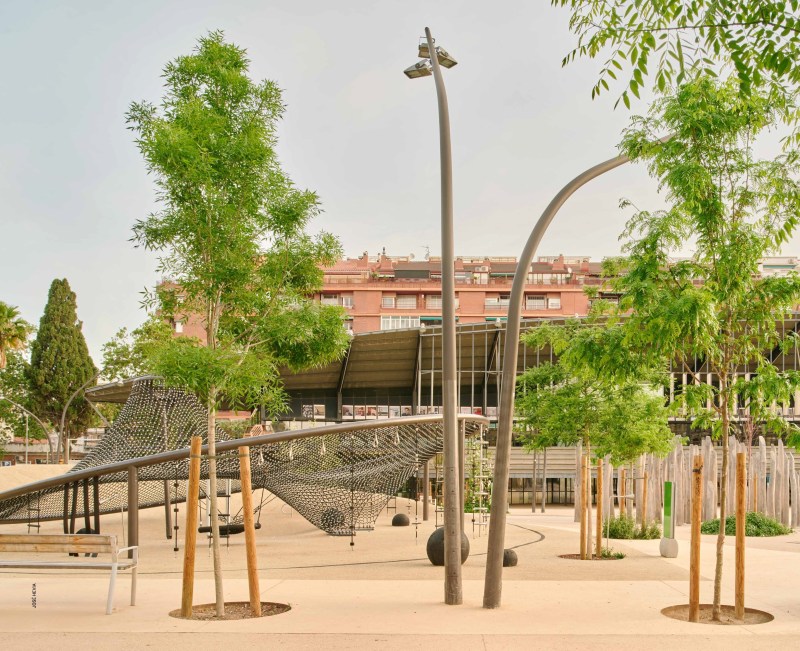
The recently completed Plaça del Canòdrom, in the northern district of Sant Andreu, has similarly been won through popular pressure – in this case, involving the conversion of a former greyhound racetrack. The Canòdrom Meridiana was Spain’s last remaining greyhound racing facility when it closed its doors in 2006 amid declining attendance and growing public concern over animal welfare. Abandoned, its grounds became a barren, dusty terrain vague, as well as a leading concern of the local neighbourhood association.
In 2009, the enclosure around the former racetrack was demolished, and restoration work began on its spectacular steel and glass grandstand, a 1964 structure designed by architects Antoni Bonet and Josep Puig. The racetrack’s grounds, however, changed little; some trees and a small playground were added. The neighbourhood’s struggle to have it converted into a dignified public space would have to continue.
Although better than what was there before, this interim square was not without its problems: it was separated from the surrounding neighbourhood by berms that had served to flatten the naturally sloping terrain for use as a racetrack, and shade was still lacking. Furthermore, it did not measure up to the restored grandstand, one of Barcelona’s finest pieces of mid‑century modern heritage, which sat somewhat lost and forlorn in its surroundings.
In 2022, a definitive plaça was finally announced after local firm Peris+Toral Arquitectes won the competition to ‘urbanise’ Plaça del Canòdrom. Their scheme sought to improve the relationship to the neighbourhood, to add more trees as well as plentiful ground vegetation, and to recontextualise the grandstand by appropriating its spindle‑shaped plan as a leitmotif for the design of the square. The architects then worked with the neighbourhood in a participatory process through which different programmatic uses were collectively determined and distributed along an oval pathway – a gesture paying homage to the former racetrack. A supergraphic of two greyhounds in the square’s surface added emphasis to this. To reunite the grandstand with the site, Peris+Toral proposed a large open space – the agora – below the bleachers, so that the ensemble could function as an outdoor theatre, or, at night, as an outdoor cinema. […]
[To continue reading, please visit The Architectural Review]

